
Homegrown in Port

PORT WASHINGTON FORESTER Jon Crain was flanked by a hackberry tree on the left and a Princeton elm on the right as he stood among the 600 trees in the city’s nursery in its industrial park recently. Photo by Sam Arendt
A mix of trees both exotic and traditional will soon find its way onto the parkways along Port Washington streets as the city’s nursery starts to produce hardy stock,
There are more than 600 trees in the nursery, which is located in the city’s industrial park. There are about 15 species and more than 60 varieties within those species. Some are common — oaks, honey locust, elms, birch, spruce and hickory, for example. Others are more exotic, like katsura trees and dawn redwoods that can grow to 165 feet.
“Two hundred and forty years from now, we’ll be able to put a road through them,” city Forester Jon Crain said.
The nursery started three years ago. Crain and his crew spent a year amending the heavy red clay soil and preparing the nursery, planting their first trees in 2018.
“I wasn’t expecting to be able to pull any out for three to five years,” Crain said. “For the first year, they kind of sit there and in the second year they really take off.
“They’re growing much better than we anticipated.”
So well, in fact, that this year he said he will take about 75 trees out of the nursery and plant them along the city streets and in its parks, replacing them in the nursery with new saplings in spring.
“It’s very exciting,” Crain said, noting the goal is to be able to remove about a third of the trees annually.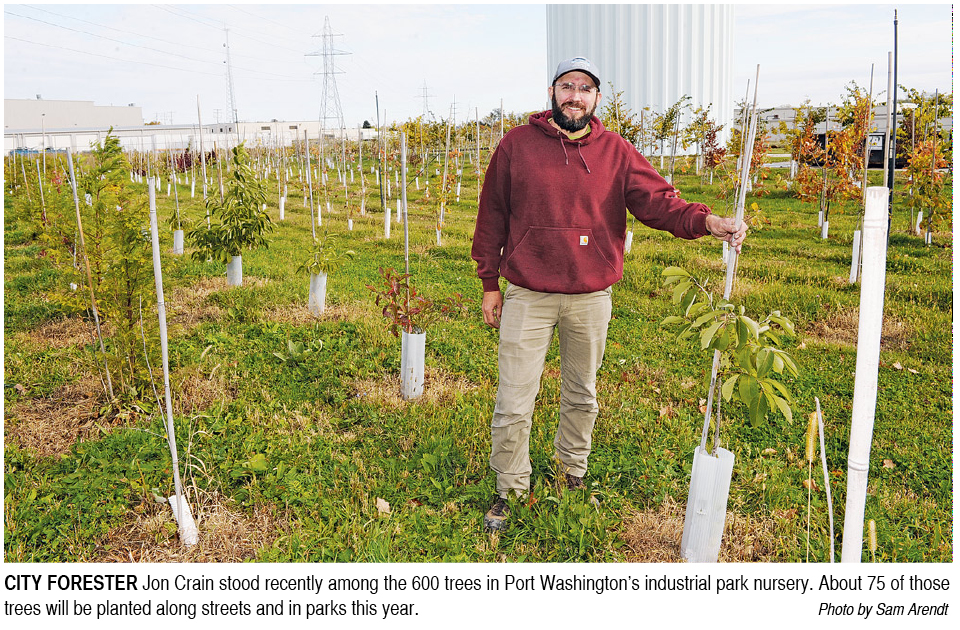
The trees are planted in the nursery when they’re about a half-inch in diameter and three to four feet high.
“Now they’re close to 1-1/2 inches and six to eight feet high,” Crain said. “They’d be even larger, but we do have to prune them.”
Port Washington is one of the few communities in the area to have its own nursery.
“I don’t know of any other,” Crain said, except Milwaukee, which has a full-time nursery staff and is a much larger community.
Crain approached the city about starting the nursery when the cost of trees went “sky high” as the emerald ash borer decimated trees throughout the state and country.
“Not only were prices going up, it was getting difficult to find what we needed,” Crain said.
A grant from the Department of Natural Resources covered the start-up costs and initial stock, and a local Boy Scout troop helped plant the trees.
“I’d like to continue that,” Crain said. “It’s a great opportunity to teach them to appreciate nature.”
The trees don’t take a lot of time, aside from pruning, he said, and the work can be fit in around other job duties.
“There’s always something to do out there,” he said.
The benefits of the nursery are many, Crain said.
The average price for a tree that’s planted along the city streets is about $100, he said, but the nursery trees are $15 to $20 each.
The city’s also able to diversify its tree stock, Crain said.
“We’re not going to have rows of Norway maples,” Crain said. “We’ve learned.”
The importance of that can be seen along the city streets. Decades ago, a canopy of large elms greeted motorists along the city streets, but they were destroyed by Dutch elm disease.
Many of those trees were replaced by ash, but then came the emerald ash borer, first found locally in Newburg in 2008. The city is treating some of its ash trees but has had to remove most of them.
In the nursery, the city is able to plant a wide variety of species — including oak, elm, spruce, hackberry, Ohio buckeye, sweetgum, musclewood, bald cypress, ironwood, black gum — and a number of different varieties within those species — eight types of elms, for example.
“Some species, we start with a small number and test them to see how they will do here,” Crain said. “We don’t have to make a large investment right away.”
For example sweetgum trees, which are borderline for our climate, are being grown.
“We’re going to try a few and see if we can get them established,” Crain said.
Planting young trees in the area helps them acclimate better to the area, he added.
“We’re essentially skipping a step,” Crain said, noting most trees found in nurseries are started out West, where the climate is different.
The city’s decision to narrow many of the streets it reconstructs, increasing the size of the parkway, and to limit the use of salt in the winter has allowed the city to use some trees that wouldn’t otherwise survive there, he said.
Katsura trees, which are native to Japan, aren’t drought tolerant, which makes it difficult to grow them in narrow parkways where the soil dries quicker. But, Crain said, “we’ve been trying them out and they seem to be doing real well.”
While the nursery is a benefit to the city today, Crain said, he’s conscious of the long-term benefit it will have.
“To be honest, everything I do with these is big-picture to me,” he said. “The majority of what we’re doing is long term. The city’s going to see the benefit long after I’m gone.”
Category:
Feedback:
Click Here to Send a Letter to the EditorOzaukee Press
Wisconsin’s largest paid circulation community weekly newspaper. Serving Port Washington, Saukville, Grafton, Fredonia, Belgium, as well as Ozaukee County government. Locally owned and printed in Port Washington, Wisconsin.
125 E. Main St.
Port Washington, WI 53074
(262) 284-3494
CONNECT


User login
125 E. Main St | Port Washington, WI 53074
© 2026 Ozaukee Press. All rights reserved.
