
Bat man
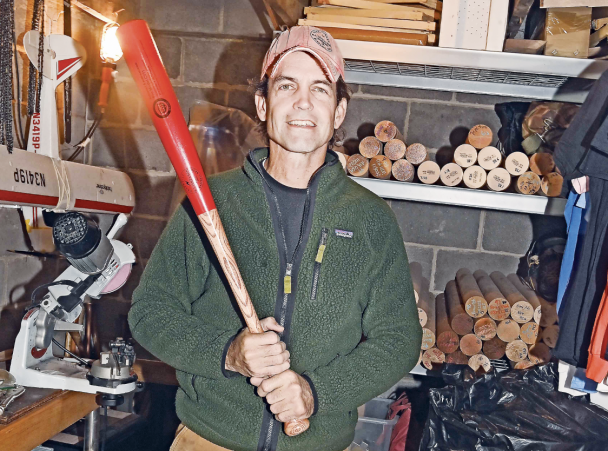
Aaron Lenz has made about 700 professional and commemorative bats. He runs the business with his teenage son. Lower, a bat with the names of all the Milwaukee Brewers who were on the field during the deciding Game 5 of the World Series this year. Lower yet, A VARIETY OF bats hang in Aaron Lenz’s shed at his Newburg home. Photos by Sam Arendt
Aaron Lenz watched the World Series with the same fanaticism as fellow
Milwaukee Brewers fans, but he paid attention to a detail most people don’t notice.
“When I watch the World Series, I see the bat maker,” he said.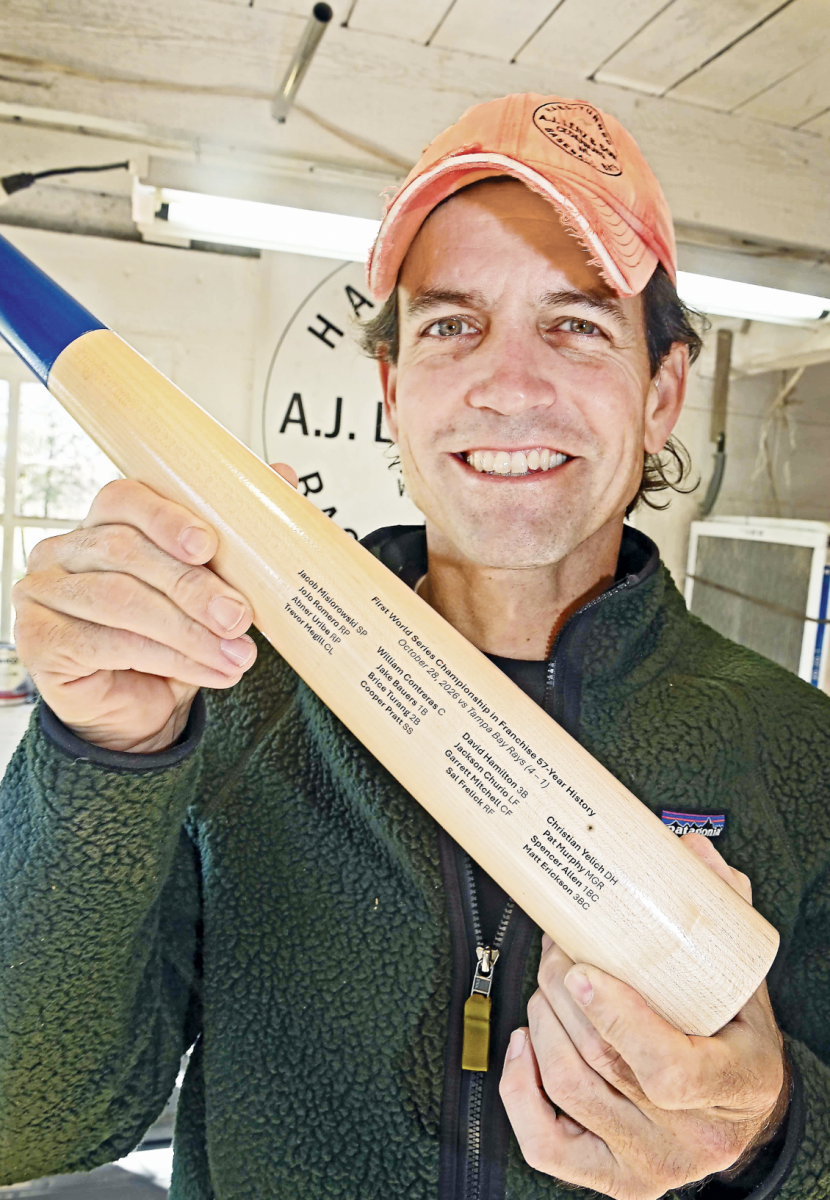
That’s because Lenz is one. His company, A.J. Lenz and Son, runs from his home in Newburg, doesn’t make bats for Major League Baseball, but professional players for the Milwaukee Milkmen have used his products, as well as players in the West Bend Sunday Night Baseball League.
“We’re in professional baseball,” Lenz said. “It’s really, really exciting and nerve-wracking watching players swinging your bat.”
It took Lenz more than 100 bats to get there. His hobby-turned business started after a friend kept urging him to do something else with the ash Lenz was splitting for firewood. He eventually bought a used lathe and tools. He gave away his first 100 bats before he started selling them.
“I was proud of the workmanship, but it was my blissfully ignorant concept of what a bat should be and not what was out in the wild being used by professional players,” he said.
The equivalent of getting called up to the majors came when the man who runs the Major League Baseball orientation and training session for new bat makers let Lenz attend the one-day course at the U.S.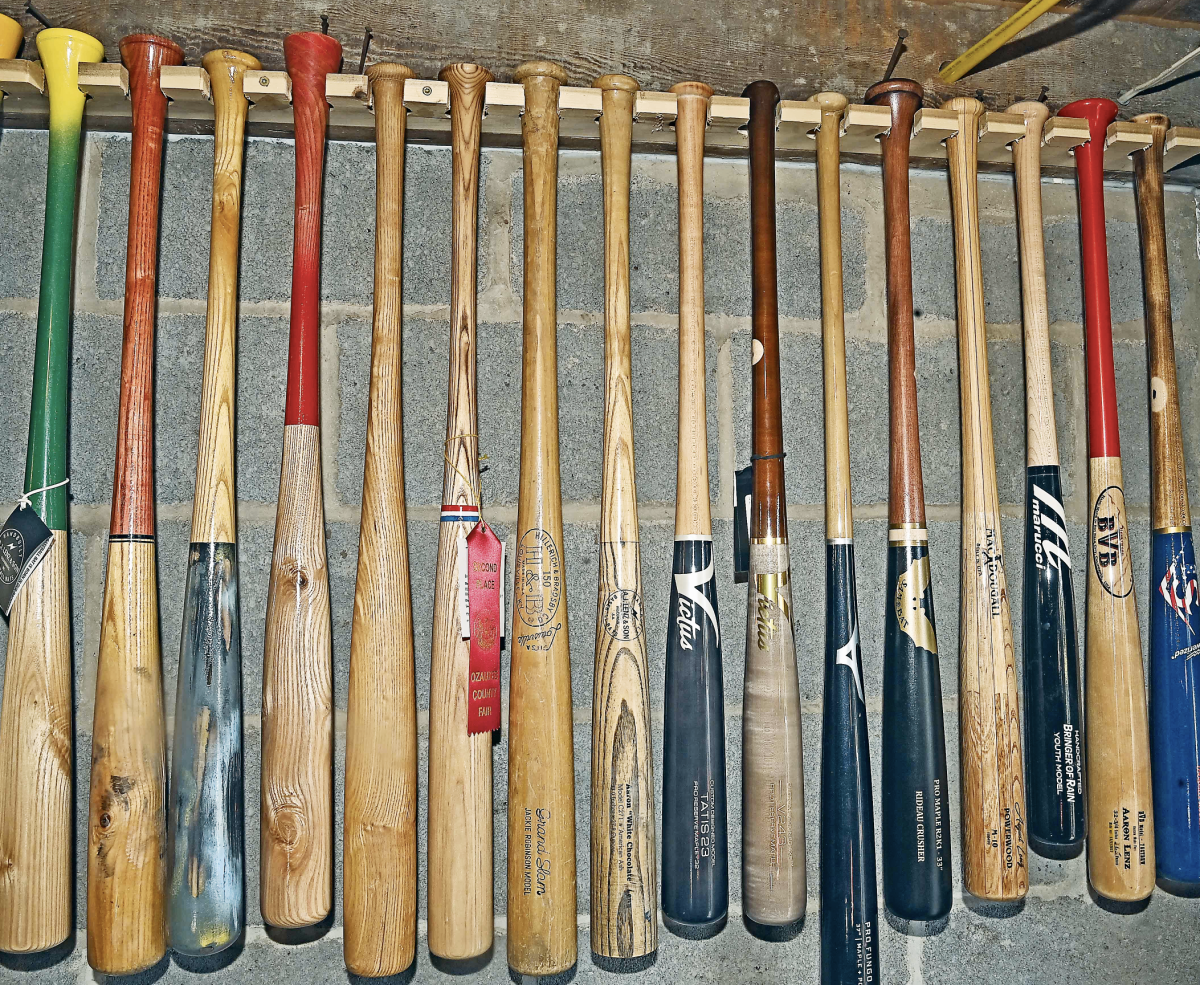
Department of Agriculture Forest Products Laboratory in Madison.
“I heard words in that room that I had never heard before. It was absolutely amazing,” Lenz said. “That was three years ago. That was part of us turning the corner.”
Lenz follows Major League Baseball standards for bats, including the ink dot test to gauge the scope of the grain. If the ink deviates by more than three degrees, neither Lenz or the major leagues will use
the bat.
To capture the exact diameter of his bats, Lenz uses calipers that are accurate to 1,000th of an inch—the thickness of a human hair.
Those kinds of details help set Lenz apart, but he wanted something else unique. He found it in stain. Lenz makes his own bone black stain.
“It’s charcoal from animal bones,” he said.
Superstitious baseball players looking for any kind of edge to gain confidence at the plate like the oddity of the stain. Powdered charcoal has been around for tens of thousands of years and was used
for cave paintings, “and it’s on your bat—do you feel dangerous now?” Lenz said.
“It’s magic. It’s got mojo.”
Lenz remains fascinated by what players say about his bats. “The feedback is incredibly specific. These guys can feel half an ounce, whether it’s there or it’s absent. Or where the weight is,” he said.
Lenz eventually landed a sales call with Burghardt Sporting Goods of New Berlin. His business wasn’t ready for that step, but “it lit a fire under us” and a year later a meeting with the company resulted in the store carrying some of his bats.
“When you see a player do well with something you made, it’s really fun,” he said.
Lenz isn’t the only one enjoying the side gig. Like a father who passes down his knowledge of America’s pastime to his son, Lenz is educating his teenager August on how to be an entrepreneur and make
bats. August has won ribbons for first and second place at the Ozaukee County Fair for his efforts.
When August was 11, Lenz took him to the bank, opened an account, got checks and a credit card, an employee identification number and registered an LLC for the WordPress website that August runs. The two also do screen printing for T-shirts.
Lenz knows about starting businesses. He has run his food safety consultant service called Lenz Food Solutions from his home since 2011.
Lenz, who grew up in Montana, studied at the Culinary Institute of America and has been a professional cook, butcher, U.S. Department of Agriculture meat and poultry inspector and worked in a slaughterhouse.
Lenz learned customer service early, once fulfilling a request for someone who came into the butcher shop right before closing time. He cut the meat and delivered it that night.
He applies the same principles to his bat business. He won’t use his stain for Jewish customers since his supplier can’t confirm which animals the charcoal is made from.
Lenz also has bees and sells honey, and he taps his own sap for maple syrup to sell on Etsy.
The bat business remains his favorite passion. He loves going down the rabbit hole of details of who uses what bat and why and the trends and intricate specifications.
Lenz is intrigued by the various bats stars have used, and he can make copies of any kind. In the 1950s, Jackie Robinson’s bat was more of a “wagon wheel,” Lenz said. Pete Rose used to soak his bats in motor oil to create a barrier to moisture.
Most bats today are made from maple wood. Ash used to be the dominant wood, and before that hickory, Lenz said.
Names of bats for players also interest Lenz. Christian Yelich uses a maple Louisville Slugger CY22—his initials and jersey number. Barry Bonds used a bat made in Ottawa, Canada, that had a
2.5-inch-diameter barrel—the thickest allowed—and a small handle to allow for a fast swing.
Lenz’s biggest sellers are bats for show, including customized commemorative bats. He’s making some that have the names of every Brewer who was on the field in the deciding game of the World Series.
His biggest project to date was as a thank-you to donors for the new baseball field at University School of Milwaukee. Lenz saw dead ash trees next to the field and floated the idea of making bats from the nearby wood. He made 26.
Most of his wood he uses comes from Great Lakes Veneer in Marion,Wis., which
supplies bats to Major League stars.
When it comes to swinging a bat himself, Lenz used to do it pretty well. He was an all-star, but that was in sixth grade. He got back into baseball as an adult, playing in the Sunday night league in West Bend. He said he batted .300 one season, but he is still a lot better at making bats than swinging them. He has made about 700 so far.
For more information, visit ajlenzandson.wordpress.com.
Category:
Feedback:
Click Here to Send a Letter to the EditorOzaukee Press
Wisconsin’s largest paid circulation community weekly newspaper. Serving Port Washington, Saukville, Grafton, Fredonia, Belgium, as well as Ozaukee County government. Locally owned and printed in Port Washington, Wisconsin.
125 E. Main St.
Port Washington, WI 53074
(262) 284-3494
CONNECT


User login
125 E. Main St | Port Washington, WI 53074
© 2026 Ozaukee Press. All rights reserved.
