

Meet a modern-day Rosie the Riveter
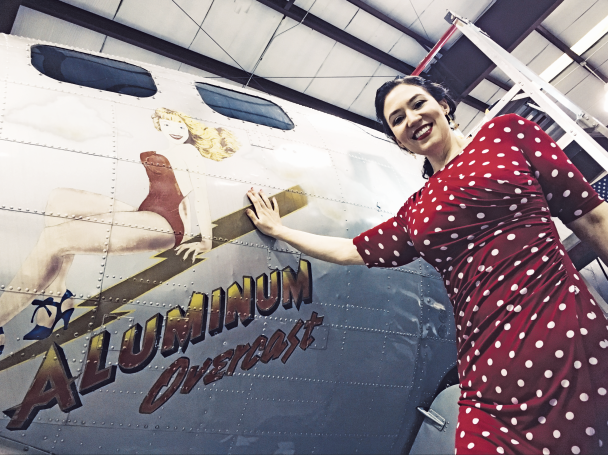
ONE OF THE PLANES Hajira Buser helped repair in 2016 was the B-17 Aluminum Overcast at the Experimental Aviation Association in Oshkosh. The work is difficult and dirty, but Buser sees it as a way to honor her grandfather and the rest of the members of the Greatest Generation. Lower, Hajira Buser, who held a handmade propeller she received as gift, has an eclectic career of teaching, running a traveling ballroom dance studio while repairing vintage warbirds as a hobby. BUSER HAS helped repair many vintage warbirds for more than a decade. She held a wrench in an EAA hangar in 2019.
Arthur Buser Sr. knocked on the front door of his Dacada home upon returning from serving in World War II.
His wife Louise Arendt Buser was stunned. Arthur had been killed in action, the military said. She attended the funeral and was presented an American flag.
That is why Hajira Buser of Port Washington volunteers as a mechanic on warbirds, vintage military aircraft that are privately owned and restored.
“It’s a labor of love. I call it part of my legacy,” she said.
Details of her grandfather’s presumed demise are sketchy, but Buser knows his B-25 was shot down somewhere on an island in the Pacific Ocean.
He dragged wounded men into a forest as Japanese soldiers ransacked the plane.
Arthur kept a screwdriver from the plane, and one way or another it saved his life. Buser isn’t sure if he used it to repair the plane and fly it back or fix a radio and had a plane sent to rescue him.
Nonetheless, by the time he got back to base the stuff in his trunk was already divvied up. Arthur was gone long enough to be presumed dead.
“For whatever reason, the Army did not tell my grandma,” Buser said. “She finds out when he knocks on the door and he is standing there.”
Arthur kept that screwdriver for the rest of his life.
Louise wasn’t keen on her husband’s time in the service after the mysterious mix-up and sewed his flight suit into snowsuits for her children. She would only talk short periods at a time about his return, Buser said.
Buser has a photo sitting on her grandfather’s lap with the flag from his funeral.
She hoped to get more information by requesting her grandfather’s military records, but they were destroyed in a fire.
That didn’t diminish her commitment to honoring her grandfather. Just how she would go about it was the question.
Buser’s mother signed her up for flight lessons, then Buser checked with the Experimental Aircraft Association in Oshkosh for a way to help. She was told to come for a visit.
Buser’s only experience in airplane hangars was through her uncle’s private jet. The floors of its hangar were pristine enough to eat off of, she said, and gourmet snacks were readily available.
She showed up wearing white heels decorated with bows at a hangar that looked more like a car mechanic’s garage. Buser wasn’t sure about the mechanic side of old warbird aviation until her second hangar visit when she stood on the wing of a World War II bomber.
Buser dove in as one of the only women in the field and learned on the job through mentors.
“I’m learning to learn and do things that scare me,” she said.
The tools and equipment are heavy, and neither parts nor molds to create them exist. At one point, Buser said, mechanics created an oven from a hot glue gun to heat Plexiglass during a repair job.
The mechanics have access to parts lists that are marked “restricted” but have been declassified. Parts carry different names in different countries. In Britain, a fillister screw is known as “cheese-headed screw.”
Buser, whose mother is Rosie, came to be known as the daughter and granddaughter of Rosie the Riveter, the cultural icon representing women’s contributions to the war effort.
The nature of the mechanics’ job forces camaraderie. People are trying to keep planes flying that were only designed to last 100 hours in the air.
“A hangar is a great place to work. You have a shared responsibility that nothing falls out of the sky,” Buser said.
“It’s bigger than you. If you’re afraid to say you made a mistake, the results could be disastrous.”
The fact that the planes can still be repaired is one key to the Allies winning the war, Buser said. Tanks, planes and other equipment were constructed quickly and “good enough” to function and be fixed by soldiers in the field.
Buser once told her friends at a restaurant about her hobby, describing how dirty “stripping” work is, which drew looks from those who overheard the conversation.
Her friends didn’t tell her until they left that she failed to mention the word “paint.”
“It’s dirty work, paint stripping, and you couldn’t pay me to do that,” she said, but she does it as a volunteer “because of the history of my family and to preserve the service and the legacy of the men who gave so much. They call them the Greatest Generation and I get to meet a lot of that generation.”
Buser has worked on the world’s only remaining P-64. They were commissioned by the government of Thailand, which at the time was siding with Japan, so the U.S. never shipped the planes, she said.
She helped restore a B-25, the same type of plane used in the Doolittle Raid on Tokyo, and got to help fly in it.
Buser’s hobby is vastly different from her careers. She is a teacher who has lived on five different continents and runs a ballroom dance school. She holds a bachelor’s degree in early childhood education and one from the University of Galway in Ireland, master’s degrees in public policy analysis and leadership from the University of Wisconsin-Madison and in linguistics from Columbia, and a certificate from Harvard in positive psychology for elementary school students with an emphasis on language. She speaks multiple languages, including Arabic and has lived and worked in Dubai. Her father is Arabic.
Working on vintage warbirds, however, remains a passion. She encourages others to take up the hobby since its labor pool is shrinking.
The sights and sounds of the planes bring out stories from veterans that their families have never even heard.
“I have goosebumps thinking about those stories,” she said.
“For me, turning a wrench is honoring grandpa’s service and all the men and women who came together for a common cause.”
Category:
Feedback:
Click Here to Send a Letter to the EditorOzaukee Press
Wisconsin’s largest paid circulation community weekly newspaper. Serving Port Washington, Saukville, Grafton, Fredonia, Belgium, as well as Ozaukee County government. Locally owned and printed in Port Washington, Wisconsin.
125 E. Main St.
Port Washington, WI 53074
(262) 284-3494
CONNECT


User login
125 E. Main St | Port Washington, WI 53074
© 2026 Ozaukee Press. All rights reserved.
