

Taking on child-to-parent abuse
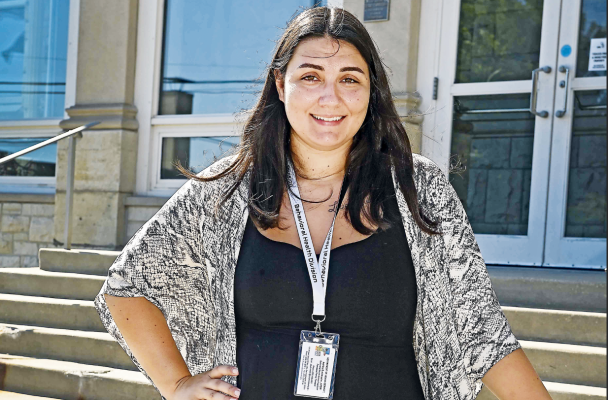
CHILD-ON-PARENT VIOLENCE is something Ashley Buckmaster encountered as a co-responder with Ozaukee County Sheriff’s deputies when she helped resolve crisis incidents. Now she is heading up a new program called Step Up through the county Department of Health Services to address what she sees as a growing issue. Photo by Sam Arendt
What goes on behind closed doors, down the street, in our neighborhoods?
It’s not always good.
Just ask Ashley Buckmaster, who has served as a behavioral health clinician with the Ozaukee County Department of Health Services and a co-responder who responded with a sheriff’s deputy to crisis situations in which drugs, alcohol or mental health issues were involved.
And now she’s taking that experience and applying it to a new first-in-Wisconsin program through the Health Services Department to address child-to-parent abuse.
“During my time as a co-responding crisis clinician with the Ozaukee County Sheriff’s Office, I witnessed family disturbance calls firsthand,” she said this week. “Those experiences were what first opened my eyes to the prevalence and impact of child-to-parent abuse.”
Data on child-to-parent violence is elusive, she said.
Last year, there were 221 “family disturbance” calls.
“I can’t say exactly how many involved child-to-parent abuse, but I feel confident in saying many involved some form of abusive behavior by a child toward a parent, whether verbal, physical or both,” she said.
Unlike child abuse, elder abuse or many mental health concerns, child-to-parent abuse is not specifically addressed within Wisconsin statutes, making it particularly difficult for first responders and mental health professionals to identify and respond to consistently, she said.
Buckmaster co-facilitates the new Step Up program, which started six weeks ago and is aimed at helping families break those cycles of violence and restore mutually respectful family relationships.
Buckmaster said it was not until she transitioned from the co-responder team to functional family therapy that she really had the opportunity to sit alongside families experiencing violence in the home.
“I noticed an ongoing theme of youth feeling like monsters and parents feeling like failures, neither of which are true,” she said.
“Functional family therapy is an effective intervention and an important part of the solution,” she said, but something more targeted was needed.
“I spent considerable time searching for Wisconsin-based resources or programs specifically designed to address child-to-parent abuse,” she said.
When she couldn’t find any state resources to help, she expanded her search nationwide, which led her to the Step Up program in the State of Washington, which she said closely aligned with what she was seeing in Ozaukee County.
She called the issue of child-to-parent abuse “extremely complex” and rooted in issues of attachment, emotional regulation, mental health challenges and behaviors learned from or modeled by adults.
Data collected in Washington show that 65% of participating youth have been exposed to domestic violence, 60% have mental health issues and 40% have been emotionally abused in the past, she said.
Staff in Washington have helped train Ozaukee County workers in setting up the program, which currently has three families participating, Buckmaster said.
While there is no local data to quantify issue, based on her experience, Buckmaster believes it’s a growing issue.
“Without effective support, there is a risk that these patterns of violence continue into adulthood or lead youth into the criminal justice system,” she said.
“I firmly believe in my heart that the children and adolescents I work with are not defined by these behaviors,” she said. “They are often highly functioning youth who are successful in many areas of their lives and experience tremendous remorse and guilt following abusive incidents.” Many struggle to regulate their emotions, she said.
“I do not think the youth that I work with are bad kids. I am incredibly hopeful for all of them and know that they can develop healthier relationships and live fulfilling lives,” she said.
She said the same of their parents, many of whom have been experiencing violence for several years.
“I continue to be inspired by the resilience, strength and unwavering love demonstrated by the parents I work with every day as they care for children who are physically and emotionally causing them harm,” she said.
Mutual respect is an important goal of the program.
“Most of the children do not respect their parents,” Buckmaster told members of the county Health and Human Services Committee last week.
A major flash point in the families is when parents attempt to restrict access to electronics.
“That’s probably the top thing that causes aggression,” she said. “They spend so much time in an electronic virtual world, they don’t know to interact.”
The program currently works with children 11 to 17 years old. She hopes that as the program grows it will expand to include children ages7 to 10.
The program involves meeting 1.5 hours per week for 20 weeks and includes attending separate youth and parent sessions and joint family sessions.
The program is currently free and open to any family living in Ozaukee County experiencing child-to-parent abuse and can be referred by any professional or can fill out a behavioral health referral form found on the Ozaukee County website.
Eventually, the program can be paid for through insurance, including Medicare and Medicaid, Buckmaster said.
The form is online at www.ozaukeecounty.gov/261/Behavioral-Health.
Category:
Feedback:
Click Here to Send a Letter to the EditorE-Edition
Ozaukee Press
Wisconsin’s largest paid circulation community weekly newspaper. Serving Port Washington, Saukville, Grafton, Fredonia, Belgium, as well as Ozaukee County government. Locally owned and printed in Port Washington, Wisconsin.
125 E. Main St.
Port Washington, WI 53074
(262) 284-3494
CONNECT


User login
125 E. Main St | Port Washington, WI 53074
© 2026 Ozaukee Press. All rights reserved.
