
The charm of a farm just for kids and animals
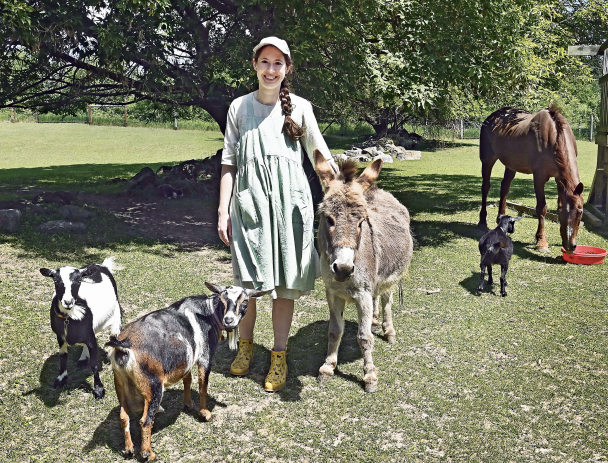
ANGELA PARSONS SPENDS time every day at Far Field Farm caring for the roughly 60 animals, including donkeys, goats, horses, chickens, ducks and cats. The creatures are friendly and will saunter over to humans for treats or scratches. Photo by Sam Arendt
Angela Parsons is preserving her grandparents’ legacy, four hooves, hundreds of feathers and handfuls of fur at a time.
Parsons is the caretaker of Far Field Farm in the Town of Saukville, a serene place despite sitting not far from Highway 57, and has brought back children’s summer camps that offer an array of hands-on animal experiences.
Campers interact with goats, sheep, donkeys, horses, chickens, ducks and cats who all live in harmony on a small portion of the 100-acre farm her grandparents bought in the early 1950s.
“The animals have my heart, that’s for sure,” Parsons said. “I love the land here and the animals, all of God’s creation. It’s in my genes.”
The camps combine two of Parsons’ passions.
“I always loved animals, just about as much as I love kids,” she said.
Parsons grew up in Cedarburg and visited her grandparents’ farm often, staying overnight once a week.
Her family moved to a house across the street when she was a teenager.
She attended Ozaukee Christian School, then Sheboygan Christian High School, graduating in 2012. She worked as a nanny and earned an associate’s degree in 2015, then a bachelor’s degree in education from Concordia University Wisconsin in Mequon in 2022.
Parsons teaches third grade at Oostburg Christian School. The camps provide some income during summer and pay homage to the farm’s history.
Parsons’ late grandmother Roberta Hypki ran camps at the farm in the 1960s and 1970s. Some sessions included overnight stays. Children were taught soil, water and wildlife conservation, played games and did farming activities.
Her grandfather Ken, who’s 100 years old and still lives on the farm, used to milk cows before turning the farm into a horse-boarding facility.
Parsons’ venture started by forming an LLC and offering a few classes last summer for children ages 7 to 13.
“I love that age of kids. They’re just so fun and curious,” she said.
Positive feedback led her to hold more camps this summer.
Her outdoor survival camp overbooked. Children were drawn to hiking, building forts, starting fires and identifying plants.
The next camp is on animal care. Children are curious but tend to be apprehensive at first.
“Lot of kids first come scared to hold the baby goats,” Parsons said. “They’ll pet them, and by the last day they’re fighting to see who holds them.”
Since many of the children are from urban or suburban settings, the camps open their eyes to a different world.
“My kids want all the animals, but they have no idea what it takes to take care of them,” Parsons said.
“We’ll probably give a sheep a bath. That will probably be a hit. There’s lots to learn.”
Parsons makes sure to let children have some freedom.
“They get their willies out. They hardly sit still. I just let them be kids,” she said. “I get the teaching stuff in there.”
Just having children play outside is a plus, she said
“It’s great to get kids off screens. There are no screens here at the farm,” Parsons said.
Her teaching is “from a faith-based perspective wanting kids to see the beauty in God’s creation, hopefully a love of nature and what God created for us to enjoy.”
Enjoying the animals comes easy.
“All of our animals are super friendly. They know humans are safe. They’re all loved and cared for here,” Parsons said.
Animals gleefully approach humans, hoping for treats or scratches.
The goats, all named after plants that grow on the farm, such as Clover, Violet and Daffodil, aren’t so thrilled with the two cats that were taken in as strays, Twix and Kit Kat, but the different species all manage to get along.
Rainy the 28-year-old horse, the farm’s oldest resident, used to be best friends with Josiah the 20-year-old donkey. Then Parsons got Oreo the 4-year-old pony, and Rainy found a new buddy.
Josiah was left out.
“He was so depressed. He was Eeyore. The mopiest donkey you’d ever see,” Parsons said.
So she added Sunni the donkey, and the two are almost inseparable.
“They share the same stall,” Parsons said.
Josiah wears a muzzle, but it’s not because he’s dangerous; he’s on a diet and the device slows his devouring. Parsons removes it each night.
She sells goat soap, and also baby goats, vetting the buyers to ensure the animals go to good homes.
“They’re super friendly,” Parsons said. “They’ll eat your weeds. Some people buy them as lawnmowers.”
Goats are, however, chatty.
“They never shut up. I think goats complain more than any of my other animals,” Parsons said. “Even with their mouths full.”
One of her sheep is a Swiss Valley Black Nose, Valais Blacknose, from New Zealand, a highly sought-after breed that looks like a mop and has a friendly dog-like personality. Parsons is building the breed through multiple generations
“That was an interesting conversation at the bank, having to wire money to New Zealand for sheep semen,” she said.
The animals live in the barn built into a side of a hill in 1888. Its nearly two-feet thick stone walls help make it cooler during summer and warmer during winter.
A cabin even older than the barn used to be a science center with deer skins and antlers and turtles shells. Now it’s used for storage, but Parsons wants to incorporate it into camps as finances allow.
Half of the 100 acres is leased to a dairy farm. The animals only use about two acres. The rest is full of trees, ponds, and wildflowers that Parsons and her brother know every inch of since they played there as children.
Hunting is not allowed on the property. Deer, turkey, owls, wood ducks, eagles, hawks and cranes have been seen.
About the only animal Parsons doesn’t have is a pooch, but she’s thinking of getting a guardian dog to protect the chickens from mink and foxes.
Parsons tends to the animals before and after school, usually for about 45 minutes each.
“I’m here every morning, every night,” she said.
Her boyfriend, a “city boy,” helps with camp forms, spreadsheets and technology.
“I like to do the hands-on stuff,” Parsons said.
Parsons’ mother Robin, who used to own shops in Cedarburg, helps provide adult supervision during camps.
Parsons also offers an art camp. Her aunt Cinder Hypki, a professional artist who lives in Baltimore, comes to help run it.
Parsons has a kiln and likes to paint, but her work on the farm and her job take most of her time.
She thinks it’s all worth it.
“It’s our little paradise,” she said. “The hope is I can keep the farm going with my grandparents’ legacy.”
Category:
Feedback:
Click Here to Send a Letter to the EditorOzaukee Press
Wisconsin’s largest paid circulation community weekly newspaper. Serving Port Washington, Saukville, Grafton, Fredonia, Belgium, as well as Ozaukee County government. Locally owned and printed in Port Washington, Wisconsin.
125 E. Main St.
Port Washington, WI 53074
(262) 284-3494
CONNECT


User login
125 E. Main St | Port Washington, WI 53074
© 2026 Ozaukee Press. All rights reserved.
