

Dairy cows’ best friend
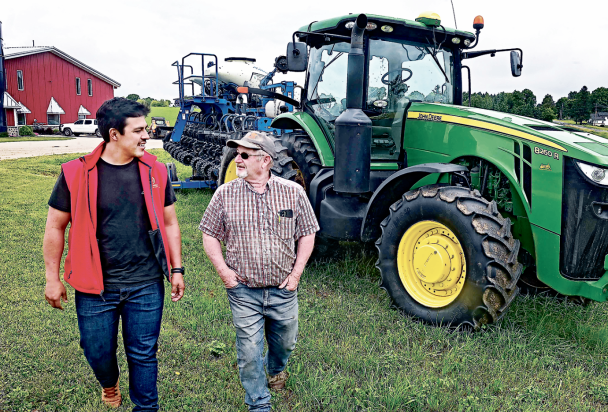
WORKING ON LAB research is an important part of agriculture, but Manuel Peña still loves interacting with farmers like he did last week with Bob Roden. Peña’s favorite cows are Holsteins (below). Photos by Sam Arendt
Manuel Peña has found home nearly 3,000 miles from where he grew up.
The 32-year-old from Colombia who fell in love with farming as a child still gets to spend time working with cows, albeit on a different level.
Peña has been the University of Wisconsin-Madison Extension bilingual regional dairy educator since last fall. He has a bachelor’s degree in animal science from National University of Columbia, a master’s degree from Clemson University and is working on his doctorate from Clemson on fiber digestion in dairy cows.
He loves research but missed interaction with those on the front lines of dairy agriculture.
“I love science and education but I feel like I’m not really connected to the community and the farmers,” Peña said.
“The lab is important, but I want to be in the field. I didn’t want to forget that part.”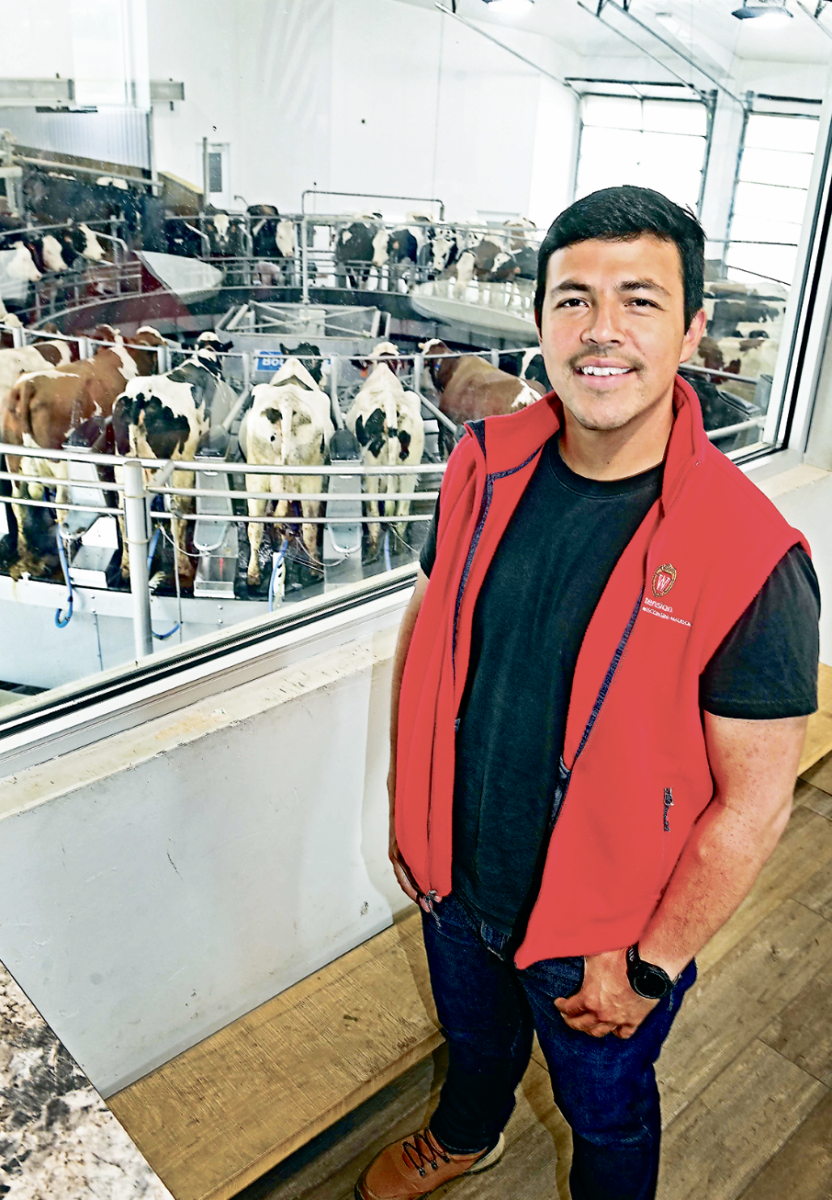
His UW-Extension job provides balance. Peña is doing research but he’s also visiting farms across his region of Ozaukee, Sheboygan, Fond du Lac and Dodge counties.
Visiting his grandparents’ farms was what got him hooked on the field. Every holiday or vacation the family took would entail a two-and-a-half-hour drive to the farm.
Peña remembers being put to work at 8 years old and being given a little money.
“It was not a farm where you go chill and relax,” he said. “We were spreading the manure across the fields, milking cows by hand.”
His grandparents had 35 milking cows, a small dairy compared to the average Wisconsin average 300 cows per Wisconsin farm.
“That’s when I started liking it the most,” he said. “That sensation of milk coming out of your hands.”
His passion was confirmed in college. He visited an ice cream shop at the National University of Colombia, then the farm where the milk came from to make the ice cream.
“That place smelled like my grandparents’ farm. I’m in the right place,” he said.
Peña started college at 16 and already could envision his career path.
“I didn’t see myself being in an office or working on anything that was not a farm,” he said. “I always felt very comfortable walking between cows and getting my clothes and my hands dirty.”
Peña’s first trip to the United States had him working part time for the University of Florida. A professor worked with the extension program there, and Peña did a seven-month internship.
After going home for a while, he did another internship working on a North Carolina farm.
Peña went home again — his visa kept running out — before his Florida professor got him in touch with someone at Clemson doing research on nutrition. Peña ended up earning his master’s degree there. It took a little longer to complete because of the pandemic, he said.
Peña kept studying, which allowed him to stay in the country longer.
“While I’m doing my Ph.D., I finished my master’s,” he said.
His work includes looking for hybrid plants for higher digestion. He experiments by planting different alfalfas.
Peña’s adviser at Clemson had connections in Wisconsin, and he found a fellow Colobian who is the UW-Extension dairy educator for Jefferson, Dane, Rock and Walworth counties. Allison Pfau did her master’s work at the University of Tennessee, and she and Peña would occasionally visit each other.
Peña landed his UW-Extension job last October. His U.S. endeavors kept him moving north. He grew up in Duitama, a city of 130,000 near the mountains of Colombia where it’s cold, “but not this cold,” he said.
Peña is now part of a transforming UW-Extension. It used to be the go-to for anything agricultural, from crops to building products and dairy rations to accounting.
As farms across Ozaukee County changed, much like the rest of the state, so did the role of the UW-Extension.
Bob Roden, co-owner of Echo Valley Farm on Highway Y, said the county had 325 permits for dairy operations in 1978. Today there are only 25.
“The cow numbers in the county have not changed. The number of farmers is what changed,” Roden said.
Roden has his own dairy nutritionist and a crop consultant, but said he still needs “some of the latest stuff they study at the university.” Peña provides that service.
While farmers like Roden get much of the technical information they need from private sources, UW-Extension services remain an important resource for dairy farmers.”The private enterprise business still falls back on extension because they feel that they have studied it the best,” Roden said.
“We do not try to compete with that. We’re trying to research and support that,” Peña said.
The difference, he said, is the UW-Extension doesn’t sell any products. It only provides unbiased research.
“We don’t have to sell any products. I feel like that’s a huge help the Extension has. We don’t have to convince the farmer to use anything. We provide information and support in the way we can,” Peña said.We won’t “tell you to go to the competition.”
One of Peña’s priorities is to communicate research and other information in Spanish. He puts out a bilingual newsletter addressing issues from farmers’ input.
“That’s big because more than 80% of the farm workers in Wisconsin speak Spanish,” he said.
Once Peña completes his Ph.D., he doesn’t expect his role at the UW-Extension to change. Nor will his diet. He drinks milk and “I eat all the ice cream I can that my arteries allow me to.” His favorite flavor is cookies and cream, and he loves garlic-flavored cheese.
His favorite cow is Holsteins. One of his academic advisers tried to convince him to love Jersey cows better, but “I could not. I love Holsteins,” he said.
Peña lives in an apartment in Sheboygan and likes to go road and mountain biking, camping and play chess at the library.
Peña has a sister who works as a chemist in Spain. His mother sells home and clothing items in a store at a mall, and his father is mostly retired after holding multiple jobs, working in sales, as a locksmith and driving a taxi.
Two of the biggest shocks Peña experienced when he came to America are its people and landscape.
He only knew of the country from what he saw on TV, which focused on New York City and Los Angeles. Coming from one of the most biodiverse countries in the world, Peña said he was surprised to see so much green space.
He also had the impression Americans only care about money, while people in the tropical part of the world “hug more and express feelings.” Ever since he arrived, Peña said, “everybody was nice to me.”
“America has given me a huge positive impact in my mind.”
Category:
Feedback:
Click Here to Send a Letter to the EditorE-Edition
Ozaukee Press
Wisconsin’s largest paid circulation community weekly newspaper. Serving Port Washington, Saukville, Grafton, Fredonia, Belgium, as well as Ozaukee County government. Locally owned and printed in Port Washington, Wisconsin.
125 E. Main St.
Port Washington, WI 53074
(262) 284-3494
CONNECT


User login
125 E. Main St | Port Washington, WI 53074
© 2026 Ozaukee Press. All rights reserved.
