
Port poised for unprecedented growth spurt
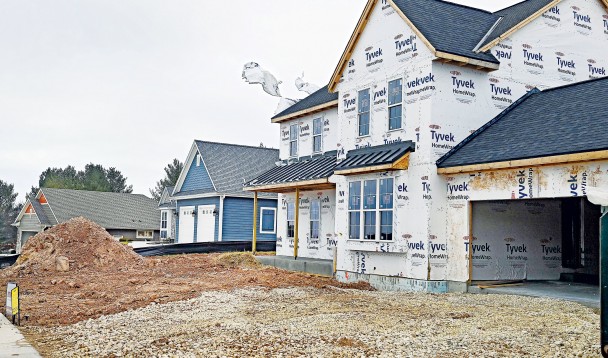
EXPECT TO SEE more residential construction like this house being built in the Hidden Hills subdivision in the City of Port Washington during the next several years. Five new subdivisions that will add almost 300 new houses to the city have been approved or are in the process of being approved by officials.
The City of Port Washington is about to undergo a growth spurt unprecedented in recent history.
Five subdivisions are currently proposed or underway that will add roughly 270 housing units to the city and potentially increase the city’s population by more than 600 people, Bob Harris, the city’s director of planning and development, said recently.
“I’ve talked to a number of long-time residents, and they tell me this is as busy as it’s been in their lifetimes,” Harris said. “The growth is significant.”
The growth is on all sides of the city — the proposed Whitetail subdivision on the north side, which would add 74 units; Hidden Hills North on the west side, 43 units; Freier Fields, on the southwest side, 56 units; Highland Pointe, on the south side, 82 units; and the first phase of Prairie’s Edge on the south bluff, 14 units, not including a 36-unit assisted living facility.
The reasons for the growth are many, Harris said.
“There’s a whole string of variables right now creating this,” he said. “I think it’s just part of the housing demand right now. Port’s a little less expensive than other communities like Cedarburg and Mequon. There are low interest rates. Millennials are going into their house-buying years.
“I don’t know if it’s pent-up demand, but it’s demand finding Port. We’re on the radar now.”
One other factor, he said, may be the 70 mph speed limit on I-43.
“It cuts the commute time and it puts Port into the Milwaukee metro area a little bit more — at least, that’s a theory I have,” he said.
He held himself up as proof of that theory, noting that before he began working in Port he never really considered the community.
“I thought as far north as Mequon or Cedarburg,” he said.
City Administrator Tony Brown said he believes a big reason people are moving to Port is simple — the city is a desirable place to live.
“The city has a housing shortage,” he said. “The demand is there.”
“We’re a destination,” Mayor Ted Neitzke added. “It’s that natural movement north. Land has opened up and now people are willing to develop it.”
The city, he added, is especially desirable for established families and retirees.
“They’re discovering Port,” Neitzke said, noting the city has a vibrant downtown, an open lakefront and recreational opportunities, including a plethora of parks.
“There’s just energy and leadership here,” Neitzke said.
There was a movement out of cities to more suburban and rural areas at the beginning of the pandemic, but Brown said he doesn’t believe that is a factor in Port’s growth.
“It seems like it was a passing phase,” he said.
Much of Port’s proposed growth is centered on the west side of the city, where land is available, Harris noted.
But these new subdivisions aren’t filled with starter houses, even though people say they want to see them.
“To me, a starter home is under $200,000. All these are over that,” Harris said. “It’s really hard to create a subdivision of less than $200,000 houses. It’s all the costs, the land costs and the cost of building.”
Brown concurred, saying, “The consistent thing I hear from developers is ‘I can’t realize a profit margin that makes sense in that price range.’”
But, he added, as people currently living in those entry level houses in the city move into their second and third houses, they are opening up starter homes for others.
“There’s a natural churn,” Brown said. “But because there is a lack of housing, that churn is not happening right now.”
The growth promises to bring significant changes to the city, officials said, as well as significant challenges.
“Overall, I think it’s a good thing for the city,” Harris said. “With more rooftops, you get more retail and commercial development. It’s also good tax revenue for the city for better services. Expanding the tax base helps everyone.
“Costs go up and if your tax base doesn’t, that’s not good for anyone.”
Brown noted that the city is only allowed to increase its tax levy by the value of new construction, giving the community the ability to maintain services as the city grows.
But, Brown said, sudden growth isn’t good because it can tax the city’s ability to expand existing services and infrastructure, especially since residential development is the most service intensive in terms of infrastructure such as roads, police and fire protections and utilities.
The city needs to analyze the impact of new development, he said, adding officials may consider such things as impact fees to help defray the cost of expanding the infrastructure to service the new homes.
Brown said most of the developers the city is dealing with now said they would like to build out 15 to 20 lots each year, a number the city may be able to absorb.
But if each of the five proposed developments add that number of homes annually, it could be a challenge — even for the city’s inspection department, which may need to temporarily increase to handle the workload, he said.
Whether the residential growth will also bring business growth is another question officials ponder.
“It’s the chicken or the egg — commercial or residential, which comes first,” Harris said. “I think commercial follows rooftops.”
The increased population will support current and new businesses, Brown said, and bring the workers that businesses today are desperately seeking.
“The key will be balanced growth,” Neitzke said. “We have to be intentional. We need to bring in business as well as residential. There should be development density, and development that creates jobs.”
But, he added, the pandemic has changed the workplace and Port may benefit from that.
“If we’re learning anything in Covid, it’s that people want to work close to home,” he said. “We make a lot of stuff here.”
One question remaining is whether the growth will continue. Harris said that’s likely. After all, when all three phases are completed, the Prairie’s Edge subdivision is projected to have 226 housing units.
“I think we’re in a good place,” he said.
Category:
Feedback:
Click Here to Send a Letter to the EditorOzaukee Press
Wisconsin’s largest paid circulation community weekly newspaper. Serving Port Washington, Saukville, Grafton, Fredonia, Belgium, as well as Ozaukee County government. Locally owned and printed in Port Washington, Wisconsin.
125 E. Main St.
Port Washington, WI 53074
(262) 284-3494
CONNECT


User login
125 E. Main St | Port Washington, WI 53074
© 2026 Ozaukee Press. All rights reserved.
