

Pasta and pat downs
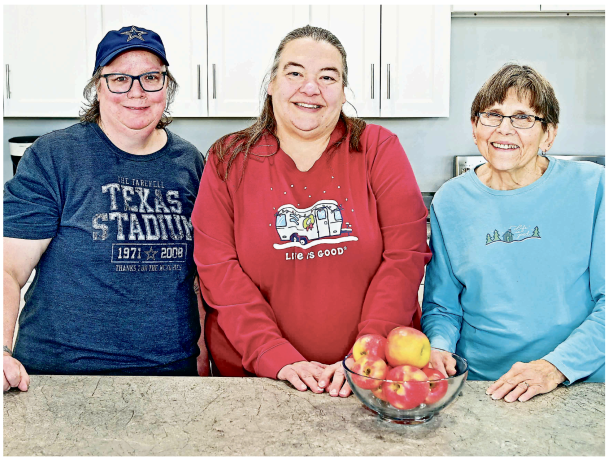
THE COMMUNITY MEAL has moved to the former Tri-Par building in Saukville, but the bond between the former Ozaukee County jail cooks remains. Among the group are (from left) Jenny Nagle, Janice Doers and Nancy Gierach. (Lower) Former jail cooks (from left) Darlene Rinehart, Sharon Zemlicka, Nancy Gierach, Janice Doers and Jenny Nagle made and served a community meal for the Ozaukee Food Alliance at Parkside Community Church in Saukville. Photos by Sam Arendt
A crew of former co-workers forged friendships while cooking for a captive audience.
But the job duties went beyond that of working in a normal kitchen for a group of women known as the jail cooks.
Pat downs for female inmates and ride alongs with deputies were part of the job for Nancy Gierach, Jenny Nagle, Janice Doers, Darlene Rinehart and the late Sharon Zemlicka.
When a female Ozaukee County Sheriff’s deputy wasn’t on duty, the cooks, since they were women, did searches of females returning from work via the Huber law and of new female inmates. Cooks were also sometimes asked to ride along with a male deputy transporting a female inmate just for security so she couldn’t claim the officer did anything to her.
“It’s amazing how much strength an 86-pound, dripping-wet female has. It was an interesting environment, I’ll tell you that,” Doers, of Port Washington, said.
“We weren’t trained,” Gierach, a Town of Farmington resident, said. She was “scared to death” when she did her first pat down in the old jail.
Then there were the times things happened inside the jail, such as a fight or escape.
“A couple of times we had to lock the kitchen door,” Nagle, of Cedarburg, said.
Sometimes, inmates became co-workers. Those with misdemeanor convictions were allowed to work alongside the cooks doing dishes or cleaning the floors, and their time qualified as good behavior to reduce their sentence.
“Most of them were really good workers,” Doers said.
Gierach only asked an inmate to leave once in her 17 years as kitchen supervisor. The inmate got cocky after getting bad news in court and started swearing.
“I didn’t allow swearing in the kitchen. We could, but they couldn’t,” she said with a laugh.
“It wasn’t a scary thing. I know people would be like, ‘Oh, you work with the inmates?’” Rinehart, of Fredonia, said. “There were cameras. The officers were right down the hall.”
What some people did to land in jail was another tale.
“Oh, we heard some stories,” Doers said with a laugh. “For the vast majority of them, it was somebody else’s fault.”
Specific protocol was set up for safety. Utensils had to be accounted for at the beginning and end of shifts, and knives were never left out, Rinehart said.
The job opened Doers’ eyes to a different world. When she started, she was a 26-year-old mother of three who grew up in Port Washington, a city with a small minority population. Doers got exposed to Hispanics and Blacks.
“A lot of these people didn’t grow up like we did,” she said, adding some never met their father.
Inmates liked working in the kitchen because they were allowed to have more food if there were leftovers.
“‘You mean I could have two pieces of dessert?’” Gierach would hear.
The jail cooks quickly got a reputation across the state. Inmates moved to other locations asked to return to Ozaukee County just because of the cuisine.
Deputies enjoyed the food, too. One favorite was tacos.
The jail cooks’ aim was to make mouth-watering meals no matter who they were cooking for.
“We took pride in what we did,” Doers said.
Recipes reached as many as 200 people since the jail sometimes housed out-of-county inmates and juveniles. Test recipes were made for 50 people.
“Everything we made was from scratch. The most processed (food) we used was maybe cake mix. We cut our own vegetables,” Doers said.
Gierach said she learned about bulk cooking while working as a cook at Port High. She started at the jail part time, then got her hours bumped up and finally was offered the lead position.
Equipment met the needs of the large client base. The skillet, called a “dump truck,” was so deep it could tip over. They could crawl into the soup kettles.
“We had a well-equipped kitchen in the jail,” Doers said.
Measurements and procedures had to be followed to a T.
“It was never a heavy half cup,” Gierach said.
Bars in a pan were cut in a certain way to maximize the yield. Gierach figured out that 10 pounds of pasta can feed about 100 people.
They learned that cooking eggs in an oven made them easier to peel for egg salad.
“Your thumbs would bleed from all those shells,” Doers said.
She remembers the traditional turkey dinners served in late November.
“Thanksgiving stuck in my mind. Deboning all those turkeys,” Doers said. “To this day I hate deboning turkeys.”
Ham was made for Easter, and food allergies and religions were respected. Pork was taken off the menu and accommodations were made for Ramadan, when Muslims don’t eat during daylight.
The cooks also had to alter the food for safety. Sticks were taken out of corn dogs so they couldn’t be used for weapons.
“Normal people don’t think about that stuff,” Doers said.
The menu stopped at steak.
“That they didn’t get,” Gierach said. “There was a budget.”
She did the ordering and took deliveries at 6 a.m. Doers remembers cases with 30 pounds of butter.
Old habits haven’t left. Rinehart said she still reacts when a knife is left lying on a counter at home.
“It’s funny how those things stick with you,” she said.
The cooks had some favorite meals. Rinehart liked lasagna despite it being “putzy” to make.
Nagle liked chicken gumbo soup. Doers liked cornbread with butter and honey. She still makes thick vegetable soup with lentils and barley and uses the jail’s old recipe for coleslaw.
The cooks started to find other jobs when the jail began using an outside vendor to make the meals, but they still get together when they can.
One of their reunions is to make the Ozaukee County Food Alliance’s community meal, and they still sometimes use recipes from the jail. The cooks spring back into action like it’s old times. Their camaraderie never left.
“Sometimes you just click, and that’s what happened to us,” Gierach said. “They were all so dependable. They knew what they were doing.”
“Our personalities just all got along really well,” Doers said.
“I really enjoyed the work and the people I worked with,” Rinehart said.
Nowadays, there is one difference in the chain of command, however.
“I’m done being boss,” Gierach said.
The cooks often make homemade meals, and some still cook as a job. Nagle is a cook for the Northern Ozaukee School District.
They all still cook from scratch. Gierach has her own macaroni and cheese recipe.
“You don’t use Kraft. You do homemade,” she said. “It just tastes so much better than packaged junk.”
Gierach, whose husband Mark is executive director of the Ozaukee Food Alliance, said clients regularly request baby carrots or chopped lettuce. She prefers cutting her own vegetables.
“Today’s people are becoming lazy, and manufacturers are helping,” she said.
“Nancy always told us what we did was a lost art,” Doers said.
Category:
Feedback:
Click Here to Send a Letter to the EditorOzaukee Press
Wisconsin’s largest paid circulation community weekly newspaper. Serving Port Washington, Saukville, Grafton, Fredonia, Belgium, as well as Ozaukee County government. Locally owned and printed in Port Washington, Wisconsin.
125 E. Main St.
Port Washington, WI 53074
(262) 284-3494
CONNECT


User login
125 E. Main St | Port Washington, WI 53074
© 2026 Ozaukee Press. All rights reserved.
