

Once-disparaged hellebores deserve an apology
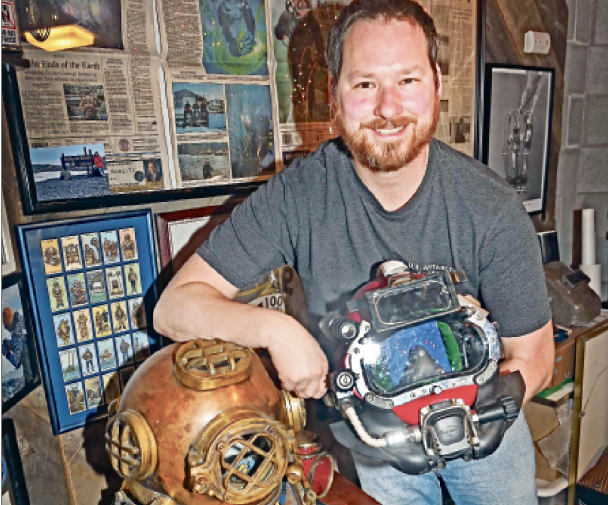
JOHN DITKOF HELD his diving helmet while leaning on an old version in the basement of his Port Washington home decorated with diving memorabilia. Lower, John, in specialized gear for deep water diving in frigid temperatures, prepared to descend into Antarctic waters. Above photo by Sam Arendt
John Ditkof was several feet underwater doing his thing when he felt a tug on his diving umbilical cable.
A sea otter wanted to play. Ditkof obliged. He soon felt a tug on his boot. The animal wanted to play some more, then bit Ditkof and swam off.
“Sea otters are something else,” he said.
That’s one of the countless experiences the 39-year-old Port Washington resident has had in building a remarkable diving resume, all in less than a decade.
Ditkof has hit all seven continents, all five oceans and all 50 states. He’s the only commercial diver in the United States to have worked in both polar regions — he did McMurdo Station in Antarctica and the Arctic six months apart — once worked 599 hours in 47 straight days and has recovered relics from a crashed World War II plane.
“It was amazing. I had no idea what I was going into,” Ditkof said of the career.
Ditkof did know what he didn’t want to do. The 2004 Brookfield Central High School graduate signed up for the Navy before senior year. He wasn’t interested in college, and his family has a history in all branches of the military, dating back to two of his great-great-grandfathers being doughboys in World War I and a cousin who stormed Normandy during World War II.
Given that the country was in the middle of the war on terrorism at the time and had invaded Iraq a year earlier, “My parents tried to talk me out of it,” he said.
But Ditkof was in. He served as a torpedo man on the USS Howard off the coast of Iraq, protecting oil platforms. He helped inspect 62 vessels in two and a half months, as well as doing goodwill missions and gathering intelligence from fishermen.
Ditkof turned 21 in Australia and did work with the Indian Navy in Mumbai before his time in the service was up. Then he studied geology and planetary science, presenting a paper on finding evidence of past life on Venus at conferences in San Francisco and Cancun.
Late in his 20s, Ditkof decided to enter the trades. He attended welding school in Wisconsin on the GI bill, then decided to pay to attend a diving school in Florida. His experience during a stick welding exercise in middle school and SCUBA diving during space camp piqued his interest in the fields.
Ditkof landed a job and lived out of his van in Florida — he showered at a fitness center — to save money for a helmet. On day 97, he earned enough money to buy the $6,500 piece of equipment that now goes for $8,600.
Once that job was done, Ditkof drove to Alaska for his next one. By then he was a freelance commercial diver with welding skills— one of 3,300 in the country and 7,000 worldwide —who had to constantly search and network for his next gig.
One stop at Sand Point, Ala., where Ditkof helped pour 25,000 pounds of concrete, breaking 50-pound bags by hand for 12 hours a day. He lost 10 to 15 pounds, then another five when he got home and slept for three days. Everyone on the job got ripped muscles but housing conditions were rough.
The next job was at Martha’s Vineyard.There, he helped salvage a Curtiss SB2C-4E Helldiver, a World War II bomber that crashed in 1946 and was stuck in mud. Ditkof, who had certification in unexploded ordnance disposal, found human remains, a 30-caliber machine gun and a gyroscope.
Ditkof’s longest dive was 509 minutes to help rebuild a collapsed pier in St. Petersburg, Fla.
“It was exhausting. I got accepted by the fish down there,” he said, adding he got nipped at and had to push the aquatic vertebrates away.
The water temperature was 90 degrees.
“You’re still sweating in the water. It sucks,” Ditkof said.
During a four-and-a-half-hour dive at Palmer Station in Antarctica — second longest in that program’s history — Ditkof welded 250-pound anodes to steel pilings 13 feet beneath the surface. The anodes protect the steel from rusting. Some of the work was done while Ditkof was upside down.
“It was just wild,” he said.
At McMurdo Station in Antarctica, Ditkof dove into Lake Fryxell in a hole through 10 feet of ice and collected material from bacterial mats thought to be clues from early life..
“It looks like mud. The scientists love it,” he said.
He also did cave diving under the water. The water was 36 degrees. Hot water flowed through his suit to keep him warm.
Ditkof wore 60 to 100 pounds of gear, depending on the dive. His helmet alone was 30 pounds.
Ditkof’s deepest dives were at 190, 189 and 186 feet, all in Valdez, Alaska, for the Environmental Protection Agency. He surveyed the sea floor for waste from fish and crab processing plants that can create a dead zone and destroy a local area.
Other sights were more pleasing. Curious female sea lions in Antarctica weighing 1,200 to 1,500 pounds would sometimes come to visit and be shooed away. The only male, a 2,500-pounder the crew named Earl, would also stop by to say hi.
Ditkof has swum through schools of red and blue jellyfish “like National Geographic. You can’t make this up,” he said.
He has seen giant sponges on the seafloor 115 feet down.
Above the surface, sunrises, sunsets and mountainscapes took Ditkof’s breath away, and he sailed through the Strait of Magellan during a lunar eclipse.
“The scenery is absolutely insane, epic,” he said.
Ditkof later went through medical training —all divers must know CPR, first aid and be emergency oxygen providers — and he went a step further to be licensed at stations where a hospital or doctor is at least an hour away.
After two months of training, Ditkof went on a 13-member medical trip to Rwanda, treating 1,000 patients in less than five days.
“I did that trip because I wanted the experience to be a better medic for my guys,” he said.
Ditkof’s interest in diving didn’t come from his parents, but his work ethic might have. His father Martin is a retired attorney who is working on his Ph.D. and trying to start a national database for people harmed by asbestos.
Ditkof’s diving experiences make the fact that he has completed multiple marathons look like a footnote. He once did the Dopey Challenge at Disney World in Florida, running 5 kilometers, 10K, a half-marathon and marathon in consecutive days.
Now, Ditkof stays closer to his wife and children in his second year teaching welding at Waukesha County Technical College. Diving isn’t off the table, but it has to work around his school schedule.
Ditkof has students from teens to adults who aren’t going to be welders but are required to take the class. They get more than an experienced welder sharing his expertise; they get to hear Ditkof’s diving stories from the man himself.
Category:
Feedback:
Click Here to Send a Letter to the EditorE-Edition
Ozaukee Press
Wisconsin’s largest paid circulation community weekly newspaper. Serving Port Washington, Saukville, Grafton, Fredonia, Belgium, as well as Ozaukee County government. Locally owned and printed in Port Washington, Wisconsin.
125 E. Main St.
Port Washington, WI 53074
(262) 284-3494
CONNECT


User login
125 E. Main St | Port Washington, WI 53074
© 2026 Ozaukee Press. All rights reserved.
