
Music Decoder

Pete Billmann loves music as much as anyone but doesn’t listen to it the same way.
A transcriptionist for sheet music publisher Hal Leonard in Milwaukee the past 26 years, Billmann cannot hear a tune without analyzing it.
“I’m always kind of thinking about it,” he said. “It doesn’t mean I don’t enjoy it.”
Billmann, of Port Washington, has transcribed and arranged guitar parts from famous songs by everybody from the Beatles to Billy Joel and from country to blues artists.
“I’ve transcribed just about every major artist in every style,” he said.
Transcribing, Billmann said, is putting audio into a written format. That skill was more useful when he started out in the pre-internet days because sheet music was hard to find and orders could take weeks to arrive.
Billmann transcribes four measures at a time and slows down recordings if necessary. He does the vocals first to keep his place, then the guitar parts. He has his 1967 Gibson ES-175 guitar, which he bought in 1993, sitting next to him to play just in case he needs it.
“There are some rock guitar players I like but they’re hard to transcribe,” he said.
The good ones are so precise that it’s easy, he said, but those who are “kind of sloppy” are more difficult.
If they miss a note or a string in a song, he will write it out.
“If the mistake is in the recording, it’s going to go into the transcription,” he said.
The casual listener may not catch it, but Billmann does. 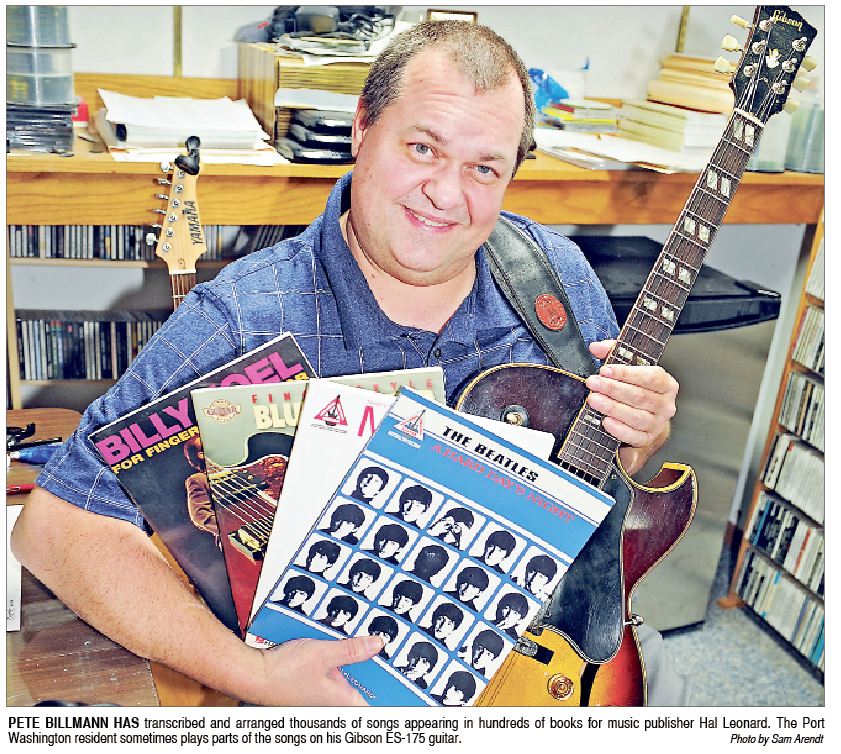
Songwriters in most cases, he said, don’t write their songs in detail. They do the lyrics and chord symbols, record demo versions and develop songs from there.
“A lot of these people never learned to read music,” he said.
But Billmann did, and that’s what opened performing opportunities early in his life.
He took piano lessons when he was a child and then learned drums. He said he didn’t take piano seriously enough and drums always need an accompaniment. Guitars, however, could handle melodies by themselves.
Billmann didn’t have a guitar, but his older brother had an acoustic model that Pete borrowed and started playing chords.Before long, jam sessions with his friends on Friday nights turned into professional gigs because
Billmann could read music.
He grew up in West Bend and played in the pit orchestra in the community theater group Musical Masquers and in rock bands and taught at a music store.
Billmann learned early on he could play by ear and made recordings of what he wanted to learn. He was inadvertently crafting the skill that would become his profession.
Billmann attended the University of Wisconsin-Milwaukee and majored in jazz guitar performance and later transferred to UW-Madison to major in music education. After one semester, he realized teaching full time wasn’t for him, so he switched back to majoring in performance.
UW-Madison didn’t have a separate faculty for jazz guitar, so Billmann studied classical guitar, a more acoustic style in the European tradition that he said is almost like learning a different instrument.
“It’s a very challenging style, very detail oriented,” he said. “When you’re playing an acoustic guitar, there’s not a lot of room for error.”
After earning a jazz studies degree in 1992, Billmann moved to Milwaukee and taught privately and performed where and when he could to “piece together a modest life.”
While lessons were often in the afternoon and gigs were at nights and on weekends, “I discovered there are other hours of the day that could be useful,” he said.
He met some musicians who worked for Hal Leonard, the world’s largest sheet music company, and submitted some manuscripts. He was hired in 1994 and did proofreading — making sure words were in the right spot and notes were stemmed correctly — before being promoted. Billmann has become one of the company’s top transcribers.
Billmann remembers the days of hunting for albums at music stores, putting a needle on a record and listening for five seconds. Now, music can easily be found online and computer technology allows tracks to be isolated.
Some of the most difficult transcribing involves multiple guitar parts. Songs by Simon and Garfunkel, which have one acoustic guitar part throughout, are simpler, he said.
Billmann’s piano experience helps.
“All the keys are right there. It’s visually easy to see where things are,” he said.
Billmann said he isn’t a fan of music without context — songs that start with a riff “and you can just tell this is the riff they’re going to drive into the ground for the next five minutes,” he said.
Billmann also does arranging — adapting music on one instrument to fit another. That allows for more creativity. His goal is to make songs challenging but acceptable to the average player.
He loves that he has transcribed songs from some of his favorite jazz artists, including Wes Montgomery, Joe Pass, George Benson and Pat Metheny.
“Not only am I transcribing but I’m learning something too,” he said.
Billmann has learned that much of his favorite rock music, especially by the British Invasion bands, was infused by classic American blues.
The light will sometimes turn on in his head while transcribing, thinking, “Oh, so that’s where Eric Clapton got that.”
Billman teaches fretboard essentials, a theory class for guitar players, at UW-Milwaukee.
He came from a musical family. His mother played flute and piano and his father played trombone.
Billmann’s daughter is earning her music education degree and his son, although not planning a music career, loves some of the same bands as his father — Pink Floyd, Rush, Led Zeppelin, The Who and Van Halen.
Billmann met his wife Donna through Kids From Wisconsin, a select music group. She sang and Billmann played guitar.
He still performs, but that has slowed with the Covid-19 pandemic. As a result, Billmann got a part-time job with the Niederkorn Library in Port.
Billmann will perform holiday jazz songs from 6:30 to 7 p.m. Tuesday, Dec. 15. The event will be live streamed at fb.me/e/1KnCqcdcn.
Category:
Feedback:
Click Here to Send a Letter to the EditorOzaukee Press
Wisconsin’s largest paid circulation community weekly newspaper. Serving Port Washington, Saukville, Grafton, Fredonia, Belgium, as well as Ozaukee County government. Locally owned and printed in Port Washington, Wisconsin.
125 E. Main St.
Port Washington, WI 53074
(262) 284-3494
CONNECT


User login
125 E. Main St | Port Washington, WI 53074
© 2026 Ozaukee Press. All rights reserved.
