

'If you plant it, they will come'
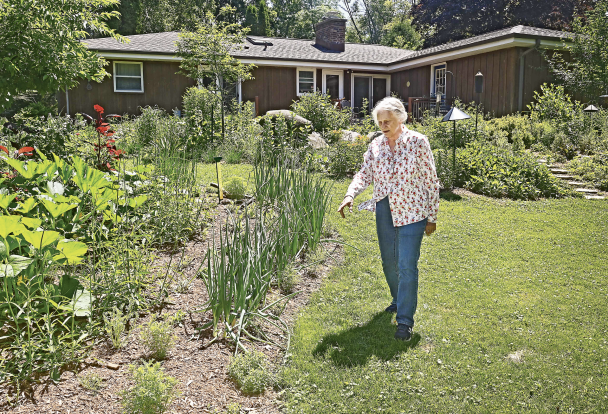
LEILA WILDER POINTED OUT a plant in one of her native gardens. A walkway through her property will allow Port Washington Garden Walk attendees to see all of the work she has put in the past eight years during Sunday’s event. Below right, coneflowers are one of her many native plants. Photo by Sam Arendt
Leila Wilder doesn’t have a relationship with nature that many can relate to.
One day, she found a garter snake in her basement. “You’re not supposed to be here,” she said.
She calmly picked up the animal with a terry-cloth towel and placed it in her backyard. It curled up and hissed at her, but she knew it couldn’t do any harm.
Wilder likes snakes. They help manage the mice and vole population on her one-acre lot in the Town of Port Washington.
Relocating snakes isn’t the only unique task Wilder takes on.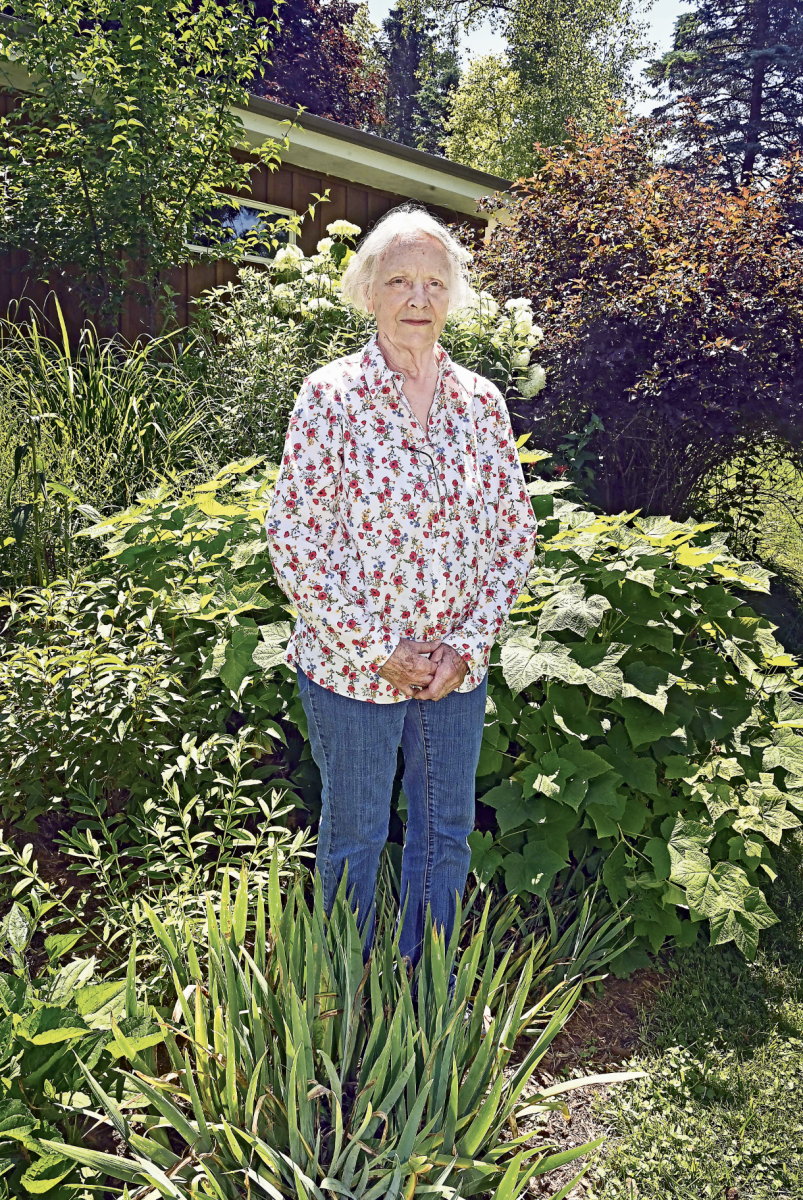
Each morning, she can be found lying on the ground in different places, carefully examining her backyard.
“I want to see what happened overnight,” she said.
She’s not looking for anything nefarious. It’s all part of her plan to go native.
Wilder has been working to transform her property, close enough to the lake to get fog and hear the roar of the waves, into a native landscape since she moved from New Hampshire in 2018.
“Every bed that you see was not here. Trees were,” she said. “This was a real shady lot.”
Now, beds of flowers, plants and vegetables grace the yard. Wilder, who has gardened for decades, knows what’s in each one and can fire off the names of their inhabitants that those unfamiliar with plants find unusual.
Wilder’s yard is one of seven on the Port Washington Garden Club’s Garden Walk on Sunday, July 19.
Wilder has irises with lineage that date to the 1860s and more than 100 native perennials. She is planning a wildflower garden for next year under a red maple tree.
“You always have to try new things,” she said.
She makes some trade-offs. Her Joe-Pye weed has damage from caterpillars, “but without them there’s nothing to eat for the birds,” she said.
“I think of my garden as if it’s for me and every other living thing.”
Wilder admits she welcomes some living things more than others.
She chased a groundhog from living near her house to the tool shed toward the back of her yard. Then she saw the animal started a family. She put stones around the tool shed, and the family relocated.
Fences partially work from turning her squash, tomatoes, lettuce, beans, kale and arugula into a salad bar.
“The deer can eat the hydrangeas instead,” she said.
Baby rabbits eat her marigolds. Wilder has seen mink, and once during the middle of one day a coyote strolled through, exuding an attitude of “I own this place,” she said.
Does have visited for years. Since the data center construction started — she is close enough to hear the trucks in her yard — nine young bucks have also come around since their habitat was taken.
Seventy to 80% of her yard is comprised of native plants, but some of the nonnative varieties can be helpful. Hummingbirds devour hostas’ nectar.
Wilder’s work has increased the number of bird species from just a few to 55. She has seen nine different woodpeckers and can hear a great horned owl nearby.
Even just a little farther inland, such as at Drews True Value, Wilder said she sees types of birds that don’t visit her yard.
Wilder is part of Cornell University’s BirdWatch, which tracks birds’ reproductive biology. She has nine nest boxes she visits twice a week. Last year, she had wrens and chickadees. This year, it’s wrens, swallows and a mouse.
“We cannot get rid of her,” she said.
Wilder is a member of the Lake Michigan Bird Observatory, and her property was on its bird walk this summer.
Come fall, Wilder mows over her leaves and pours the mulch over her flowers. Insects hide eggs under them during winter, she said.
The colder months are spent planning. Wilder took some landscape design courses, “but I think they were lost on me.
“I like a lot of variation in form and color,” she said.
In spring, Wilder holds off on planting as long as she can.
“Many insects are in your debris from your plants, especially hollow dead stems,” she said.
Wilder lays them flat so the insects can get in and out.
She also adds small stones to her bird baths so bees have an island to sit on while grabbing a drink.
“I didn’t realize how important it was. It attracted so much wildlife,” she said.
Wilder also learned that plants will find where they want to live. Some that don’t do well in one location somehow pop up in a better spot, as was the case with her red cardinal flowers in New Hampshire.
“I finally learned you don’t keep a plant where it doesn’t want to be,” she said.
“It’s hard to do everything right. You try.”
Wilder grew up in Minnesota and learned gardening from her mother, who had a huge flowerbed.
Her late husband Nick worked as an international banker and moved the family across the world. Wilder has gardened in Brooklyn, Germany, Ireland, Lake Forest, Ill., and New Hampshire before coming to Wisconsin.
Wilder and her daughter Paige, who lives a mile away, enjoy gardening together. Paige’s garden was on last year’s Garden Walk.
The pair take classes at the Cedarburg Bog and Riveredge Nature Center that inspires gardening ideas. Wilder has learned one basic idea throughout her time in the hobby.
“If you plant it, they will come,” she said.
“I hope I’m helping the environment. It’s hard to do it one acre at a time.”
Category:
Feedback:
Click Here to Send a Letter to the EditorE-Edition
Ozaukee Press
Wisconsin’s largest paid circulation community weekly newspaper. Serving Port Washington, Saukville, Grafton, Fredonia, Belgium, as well as Ozaukee County government. Locally owned and printed in Port Washington, Wisconsin.
125 E. Main St.
Port Washington, WI 53074
(262) 284-3494
CONNECT


User login
125 E. Main St | Port Washington, WI 53074
© 2026 Ozaukee Press. All rights reserved.
