

A first glimpse of falcons’ flight
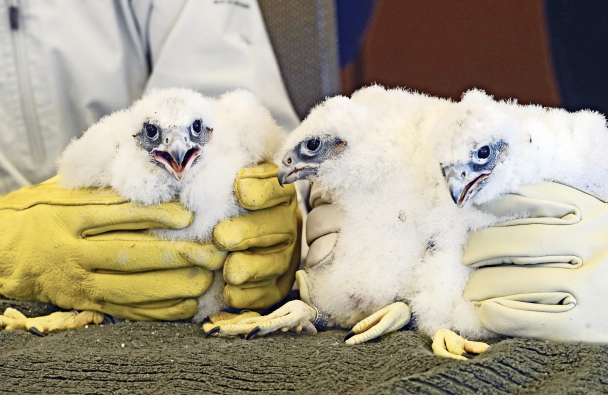
WISCONSIN PEREGRINE RECOVERY PROJECT founder Greg Septon (below) showed a tracker band attached to the leg of one of three peregrine falcon chicks (above) hatched at the We Energies power plant in Port Washington this spring. Press file photos
Gino Falcone, a peregrine falcon born and banded in Port Washington this spring, recently stopped in Norway, Mich.
That information was recorded via a transmitter on the bands placed on his legs by Greg Septon of the Peregrine Falcon Recovery Project. He said the information will be used to provide a detailed look at the movement of young peregrines.
“This is something I’ve wanted to do for the last 20, 30 years,” Septon said after the banding this spring. “Where do the birds spend the first few years of their lives? That’s my big, giant question. Do they go down to South America and come back to nest? We don’t know.”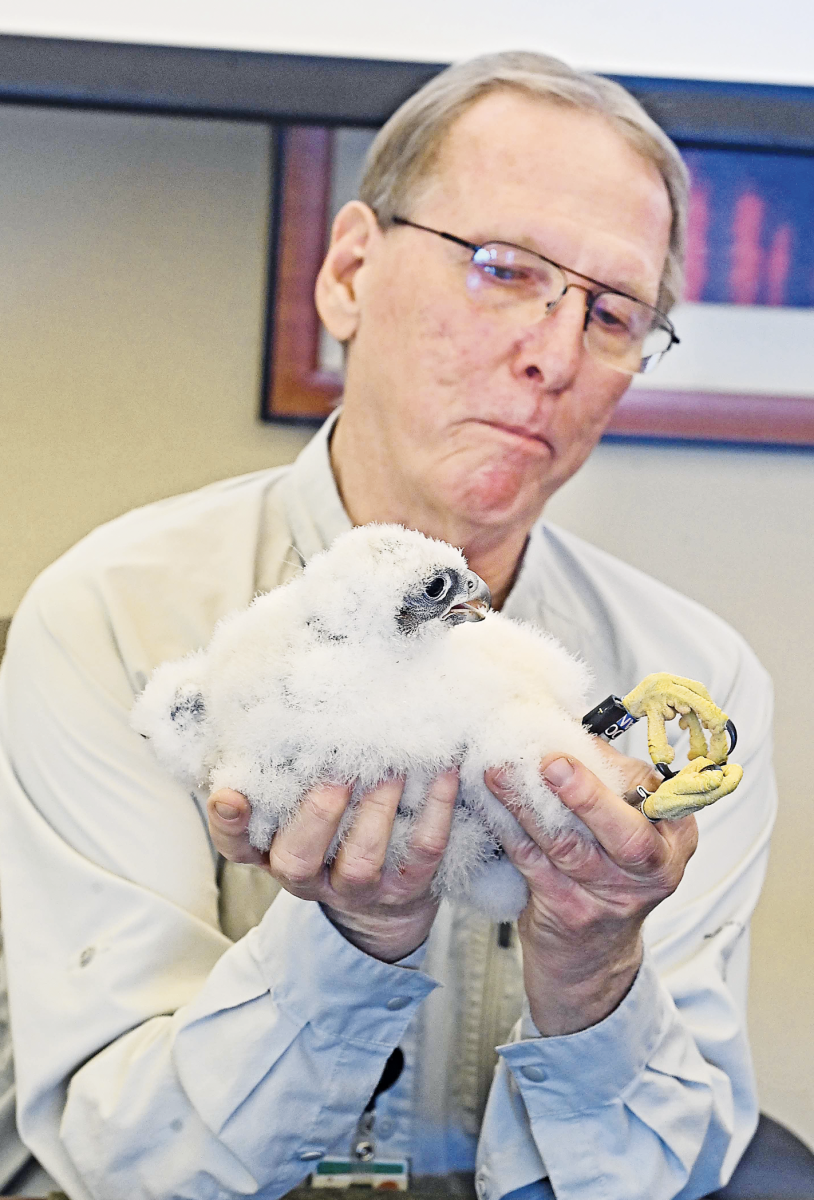
The tracker on Gino Falcone showed he made stops in Door County, northern Wisconsin and Michigan’s Upper Peninsula before his tracker pinged in Norway, Mich.
But Gino isn’t the only peregrine from Wisconsin whose information has been recorded.
According to information from We Energies, which picked up the cost of the transmitters, peregrine Brook Flighton, who was born in Oak Creek, headed to Winnebago, Ill., then headed to Door County and Clare, Mich., before going to Sault Ste. Marie. She most recently was pinged in Port Elgin, Ontario.
And Lance Talon, who was born in Milwaukee, went to Illinois, stopping in Des Plaines, Joliet and taking a “day trip” to Navy Pier in Chicago. He most recently pinged at the McCook Quarry in McCook, Ill., where he “seems to have made himself at home.”
The BluMorpho tags were on bands that were placed on all 11 peregrine chicks born at We Energies power plants this spring. Eight of the devices fell off or stopped working within the first few weeks, according to the press release.
This is only the second time these transmitters were used on peregrines in the U.S., Septon said.
“The data we have been able to collect is nothing short of incredible, and we are working with the vendor to make improvements to the transmitters for the falcon chicks born next year.”
The transmitters are about the size of the tip of Septon’s little finger, he said. They are created on a 3D printer and include the tracker, a small antenna and a tiny solar panel that powers it. The tracker is placed on a band with a dab of super gel to ensure it’s fastened.
The solar panel will power the tracker indefinitely. Location data from the tracker is picked up on Motus stations, which typically track wildlife, Terra Listens devices and, perhaps most significantly, smartphones and tablets. Septon then tracks the birds using an app.
Septon said that his goal is to develop a clear understanding of where young falcons go in their first years, before they settle at a nesting site to lay eggs and raise their own young.
Peregrine falcons nearly went extinct in Wisconsin due to the use of pesticides, particularly DDT. To support their recovery, We Energies and Wisconsin Public Service began installing nest boxes at power plants in the early 1990s.
Since then, 476 peregrine chicks have been named and banded at company sites — 20% of all the chicks hatched in the state.
The Port power plant has been the birthplace of 86 chicks since 2000.
Category:
Feedback:
Click Here to Send a Letter to the EditorOzaukee Press
Wisconsin’s largest paid circulation community weekly newspaper. Serving Port Washington, Saukville, Grafton, Fredonia, Belgium, as well as Ozaukee County government. Locally owned and printed in Port Washington, Wisconsin.
125 E. Main St.
Port Washington, WI 53074
(262) 284-3494
CONNECT


User login
125 E. Main St | Port Washington, WI 53074
© 2026 Ozaukee Press. All rights reserved.
