
Council commits to beer garden arrangement
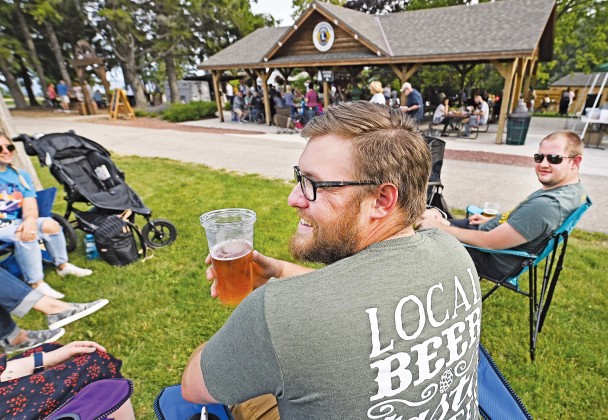
THE BEER GARDEN series in Port Washington has proven popular, drawing hundreds of people to Upper Lake Park each weekend from July through October. Local nonprofit organizations help run the events and raise money they put back into the community at the beer gardens. Press file photo
The Friends of Port Washington Parks and Recreation will run the beer garden program for the next three summers, the Common Council agreed on a 4-2 vote Tuesday.
Aldermen Pat Tearney and John Sigwart voted against the motion, with Sigwart saying he did not want to approve a long-term contract.
“I’m really interested in a second trial year,” he said. “I’m not interested in a three-year agreement.”
Tearney asked that the council postpone a vote until January to give the Friends group a chance to talk to some of the nonprofit organizations that dropped out of the beer garden series last year because of the changes made by the city.
“I have a concern there are people out there who may feel left out,” he said.
The vote to table a decision died on a 4-3 vote, with Tearney, Sigwart and Ald. Deb Postl voting for the measure.
The votes came after representatives of two of the nonprofit groups that helped found the beer garden five years ago asked that the Friends group consider a hybrid model that would allow them to hold their own event in the middle of the beer garden series.
“We’re asking for a chance to continue what we started,” Dave Mueller of the Port Washington Lions Club said. “We know how to turn in the paperwork. We know how to run a beer garden. We chose not to participate last year because of the changes implemented by the Friends group.
“We want to continue our commitment to the city and the parks.”
The two groups have invested $75,000 from the beer gardens in the beer garden area, building the stage, pavilion and other infrastructure to support the event.
Christina Brickner of Be3 agreed, saying her organization “Poured our hearts and souls into this. I walked away feeling gutted.”
A hybrid approach that would allow the two groups to operate beer gardens as they have in the past, assuming all the risk and reward on their own, is needed, she said.
“Working together we can develop a solution in the spirit that made the beer gardens a success.”
The beer garden series, held every Saturday from July through October, has been embraced by the community since it started five years ago. But last year, the city handed the organizational duties to the Friends of Parks and Recreation to help alleviate the workload on staff members.
That angered some of the organizations that traditionally hosted beer gardens, who said that the plan would remove much of the charm from the individual events.
The groups also argued that the fact that the organizations would evenly split the profit from the beer garden series was a disincentive, noting there is no reason to put more effort into making the beer gardens a success if the groups did not realize the reward.
Justin Myers, president of the Friends group, told the Common Council that last year was a successful one, with his group handling the organizational duties for each of the 15 weekly beer gardens and nonprofit groups supplying the volunteers to staff each event.
“We had a lot of fun. We learned a lot,” he said, adding 12 of the 14 participating nonprofit groups — the Friends group was the 15th this year — have indicated they want to return to the series next year.
The beer gardens brought in $57,400 with expenses totalling $33,800, Myers said. The net income was $23,415, which was split between the 15 nonprofits, meaning each received $1,561.
The Friends group was authorized to take half the net profit from the beer gardens, Myers noted, but because it operated one of the weekly events decided to take the same amount given to other nonprofits.
The nonprofit groups also received all of the money received in tips, from raffles and merchandise sales, he said, typically $300 to $400.
The Friends group, he noted, returns the money it raises to the parks department. It has paid for the external lights on the lighthouse, the snow globe for Santa in a Snow Globe, lacrosse equipment for the recreation department, hammocks in the parks and a number of beer garden amenities, including bathrooms, string lights and tables.
Recreation Director Kiley Scherer said a three-year agreement with the Friends group was sought so the organization could make some long-term plans for the future of the beer garden.
“You really need to plan for the future,” she said. “Looking one year at a time is a struggle to plan. This year was a success and we can take a three-year term to see what they can do with it.”
Myers said the Friends hope to do more marketing to drive up attendance in the coming years, find sponsorships to offset the operating costs and increase the net revenue to be split between the nonprofits and will look at ways to tailor the revenue-sharing to reflect the fact that some groups do more marketing and work on the events.
Although aldermen took no stand on the hybrid approach, they urged the Friends group to meet with the nonprofits to discuss the matter and come up with a solution.
But the shared profit may prove to be a deterrent to some of the participating nonprofit groups.
Sigwart, who is president of the Kiwanis Club, said the organization typically makes $3,000 on its beer garden, plus $600 in tips. The group initially decided not to participate next year because of the profit sharing, he said, but new rules by Kiwanis International caused them to rethink that decision and agree to take part in 2022.
Barbara Bates-Nelson, executive director of United Way of Northern Ozaukee, said the organization made $4,400 on its beer garden in 2020, far more than this year’s profit.
While she appreciated the help the Friends group gave in terms of organizing the event, Bates-Nelson said, the group has limited resources and will look at the return on the time invested in the beer garden to determine if United Way will participate next year.
They would like to have more control over the food and beer served, as well as the music, she said.
“They were kind of cookie cutter events (this year),” she said. “We lost some of the uniqueness.”
Robert Fechner, president of the Port Rotary Club, said the club hasn’t talked yet about whether to participate in the beer garden next year but he acknowledged the $1,500 they made last year is less than the Rotary typically makes on the beer garden.
But, he said, the beer garden is more than just a fundraiser for the group.
“It’s about bringing together the community,” Fechner said. “You just go there, and normally when you go there you will see friends there. It’s something to give back to the community.”
Category:
Feedback:
Click Here to Send a Letter to the EditorOzaukee Press
Wisconsin’s largest paid circulation community weekly newspaper. Serving Port Washington, Saukville, Grafton, Fredonia, Belgium, as well as Ozaukee County government. Locally owned and printed in Port Washington, Wisconsin.
125 E. Main St.
Port Washington, WI 53074
(262) 284-3494
CONNECT


User login
125 E. Main St | Port Washington, WI 53074
© 2026 Ozaukee Press. All rights reserved.
