
Cold memories of the Antarctic
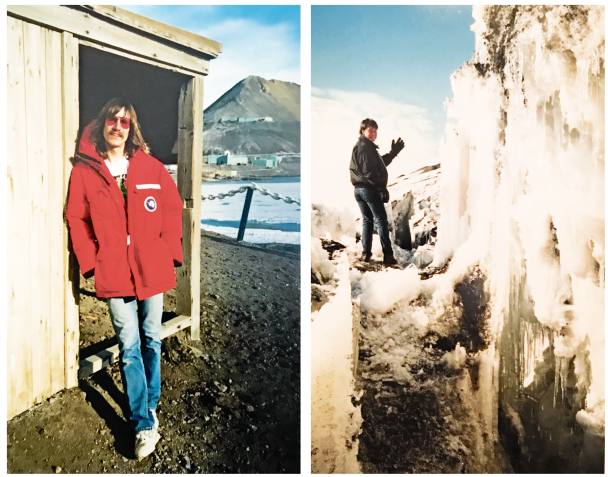
RON DICKSON STOOD next to Scott’s Hut (above left) on Ross Island in Antarctica. The building was constructed during the British Antarctic Expedition between 1910 and 1913 led by Robert Falcon Scott. Dickson’s friend (upper right photo) sometimes took hikes with Dickson in Antarctica while they worked on the continent. Falling into crevasses (bottom right of photo) were a danger. (Lower) Ron Dickson of Saukville held his passport stamped with Antarctica and the South Pole from his time working in cargo for 27 months at McMurdo Station. Photo by Sam Arendt
Ron Dickson of Saukville remembers well the first and last time his plane landed in Antarctica.
On his inaugural trip, he wasn’t even seated near the door but the 32-year-old felt a frigid rush when it opened.
“The cold just penetrates you,” he said.
The wind chill was 70 below, not by far the coldest Dickson would experience on Ross Island just north of the mainland.
By the fifth time he arrived, “I didn’t even bother to zip up my coat and didn’t wear gloves. It was fine,” he said.
Dickson spent five seasons spanning 27 months in the late 1980s and 1990s working for the Antarctic Support Associates. Some of the time was during winter when it was dark 24/7, and some during summer when it was light all the time. He stayed in McMurdo Station, the biggest U.S. community in Antarctica that swelled to about 1,250 people at its peak.
Dickson worked in cargo the first couple of times, comparing his job to being a hardware store salesman. The last couple of stints he was in charge of a parts warehouse.
“Things break. Things break a lot,” he said.
Most of the parts were for Caterpillar machines or Ford pickup trucks.
Work was supposed to be called off when the wind chill reached 100 below, but once while crews were preparing for a rescue flight a part was needed for a machine that would clear a path to the airport.
Dickson went outside and used an M4K forklift — a heavy-duty Army vehicle — to shovel out the part from a tall and long pile of items called a cargo line.
He returned with the part to learn work had since been stopped due to the weather.
Another time, he was taking apart a science camp of two scientists who studied temperature-induced wind 400 miles from the South Pole and 400 miles from McMurdo Station. It was too far for a helicopter to travel, so a C130 plane took him there.
The trip entailed the pilot determining the direction of the wind by the snow formation on the ground away from crevasses. Dickson couldn’t figure out why people would study wind in one of the coldest and windiest spots on the planet.
“What a horrible idea,” he said.
Other research was more intriguing. Dickson helped set up a science camp in New Harbour west of Ross Island so people could study and harvest natural glue made by single-cell organisms. The top reason patients reject artificial hearts, Dickson said, is because of the glue.
One excursion had Dickson using a flatbed to recover a helicopter that crashed in whiteout conditions in October 1992. Three passengers were killed and the pilot and copilot barely survived.
Nobody gets attacked by polar bears — the creatures only live in the North Pole area. A leopard seal in Antarctica once bit a woman, then let go when she screamed and the animal realized she wasn’t a penguin.
The other type of seals he saw were Weddell seals. They were huge and harmless and would sun themselves for hours at a time, he said.
Killer whales were another sight to behold. “The whales are cool. Sometimes they’ll play and interact with each other,” Dickson said.
He lived with nine other people in a Jamesway hut, an oblong tent with forced-air heating. It was warm near the top but Dickson said his beer froze on the ground.
Antarctica is sometimes referred to as the Fourth World given its isolation.
“You felt very off-planet, which wasn’t necessarily a bad thing,” Dickson said.
The incomprehensible cold, even for Dickson, who lived in Minnesota at the time, was just one of the adjustments. Mail deliveries could take from eight days to three weeks.
McMurdo Station had no restaurants but offered a coffee bar and regular bars. Dickson learned aged ice on the continent, sometimes as old as 10,000 years, was good for scotch. The ice had compressed air that, as it melted, caused the drink to bubble.
“It was entertaining,” Dickson said.
All food was served in a cafeteria. Pork Adobo was the worst offering, Dickson said. Someone turned it into a song to the melody of “Mellow Yellow.”
Despite living near water, fishing wasn’t allowed. The only seafood Dickson got was when a scientist gave some away from a research mission.
The Navy was in charge of morale, welfare and recreation. Volleyball and basketball leagues were held in a gym, and anyone sent to Antarctica who could play an instrument was encouraged to bring it along for entertainment. TV was only closed circuit, and news from the world wasn’t consistently updated.
Dickson handled all kind of cargo, from food to people. He even moved material for other countries. He couldn’t believe Russians were giving their workers “little rotted potatoes.”
After “absolutely minimal” training, Dickson was part of a civilian crew that took over handling cargo from the Army. On-time and accurate deliveries increased from 30% to 98%.
Dickson was used to the cold since from his time in Minnesota, but the effect of extreme frigid and dark conditions made an impact. Dickson only paid attention to wind chill, which ranged from 60 below to 114 below. During his winter jobs, he was basically part of a skeleton crew that maintained the place.
“You slowed down and you seemed to require more sleep,” Dickson said. “By the time the new people would come in, you were referred to as toast.”
During summers, the sun would hit the horizon on Oct. 1 and wouldn’t reach it again until February. On nice days, temperatures could eclipse 40 degrees.
“Everyone’s walking around in cutoffs and flip-flops and T-shirts,” Dickson said.
He flew to the South Pole once and spent 40 minutes there. The pilot kept the plane engines running.
Despite the conditions, Dickson enjoyed his unique work experience and fit in well because of his experience in a machine shop and the fact that he was a jack of all trades.
Not everyone working with him lasted. “Some people do one season and they never go back again,” Dickson said. “We called them tourists.”
His interest in the job came from his father Adrian, who worked on an Arctic island perfecting hydrophones that allowed the U.S. to pick up Russian submarines 1,100 miles away. Dickson said the construction quality of the vessels was so bad they could figure out which sub was which just by its sound signature.
“They had no superiority as far as submarines went,” he said.
His father also worked for General Motors and helped make components for the lunar vehicle that was driven on the moon. Adrian did one of the final checks on the electronics on the car.
Dickson would have returned to Antarctica but he got married and didn’t want to spend that much time away.
“There were (married) people doing it but I don’t think they were happy,” he said.
Dickson and his wife have lived in Saukville since 1993. He works at KMC Stampings.
He still has fond memories of his endeavors in the far south, which Dickson said are best summed up by what he saw written on a bathroom wall:
“I wish I was where I was when I wished I was wishing I was here.”
Category:
Feedback:
Click Here to Send a Letter to the EditorOzaukee Press
Wisconsin’s largest paid circulation community weekly newspaper. Serving Port Washington, Saukville, Grafton, Fredonia, Belgium, as well as Ozaukee County government. Locally owned and printed in Port Washington, Wisconsin.
125 E. Main St.
Port Washington, WI 53074
(262) 284-3494
CONNECT


User login
125 E. Main St | Port Washington, WI 53074
© 2026 Ozaukee Press. All rights reserved.
