

A cancer cure? He’s working on it.
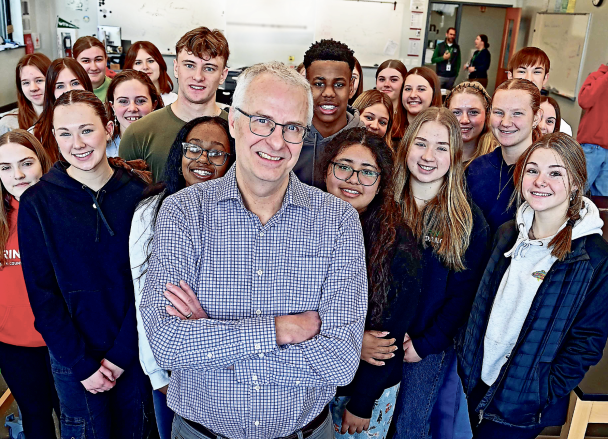
Cancer researcher, professor, physician and Port High graduate Matthew Vander Heiden met with students in the Project Lead the Way Biomedical Innovation/Medical Innovations class at the high school, where he was named to the Wall of Fame last week. Lower, VANDER HEIDEN held his plaque for being inducted into the Port Washington High School Wall of Fame. Photos by Sam Arendt
Matthew Vander Heiden isn’t the only one who relishes in the variety of hats he wears in his profession, but he’s one of the few who leads and inspires groundbreaking developments that make for longer lives.
Some days he’s a doctor, others a professor. But he’s always a researcher at and administrator of a world renowned cancer center that has made discoveries leading to new treatments of the disease.
Vander Heiden has been the director of Massachusetts Institute of Technology’s Koch Institute for Integrative Cancer Research since 2021. He teaches undergraduates biochemistry at MIT, treats prostate cancer patients and runs a lab doing cancer research.
After last Friday, Vander Heiden can add to his long list of prestigious honors he’s acquired throughout his career. The 1990 Port Washington High School graduate was inducted into the school’s Wall of Fame.
“This is the community I grew up in and my parents are part of it. It’s special to be
recognized in this way,” he said.
Given the esteemed positions he holds today, people tell him, “you must have had it all figured out, and I really didn’t,” he said.
Vander Heiden was the salutatorian of his class, but claims he “was a stupid kid just like everybody else” who is grateful to his teachers.
Growing up, he was interested in science and intrigued by medicine, “but I didn’t know what I wanted to do,” he said.
It was at the University of Chicago where Vander Heiden figured out his career path.
“I started in lab washing dishes. I got exposed to research and had interest in medicine, and decided to do both,” he said. “A couple of mentors and people later helped figure things out, then I sort of set off on a path and really knew what I was doing.”
Vander Heiden earned a bachelor of science in biological chemistry, then stayed in school to earn a Ph.D. in immunology and a doctorate in medicine.
Vander Heiden met his wife in college, and followed her to Boston, where she landed a job and he got a residency at Brigham and Women’s Hospital, a Harvard University teaching hospital.
He sought an academic job with backup plans in academic research or being a physician, and eventually got all three at MIT, “which is a pretty cool place,” he said.
Now, his typical week depends on the day and time of year. He sees prostate cancer patients two days per month as a practicing physician, usually those seeking a second opinion, and teaches biochemistry each spring. Most of his time is spent as director of the school’s institute for cancer research and running his own lab with fellow researchers. It’s more than a 40-hour-per-week job.
“I’m probably a bit overcommitted,” he said.
Vander Heiden enjoys working with people on both the administrative and lab sides.
“We couldn’t do the science without the administrators keeping the lights on in the building,” he said.
Vander Heiden savors that science.
“I get to go and try to discover new things and try to find a way to make those discoveries make people’s lives better,” he said.
His lab has already done some of that. Its research has led to new drugs that treat cancer.
“I have to say that’s a super cool thing, having drugs that go into clinics that help people,” Vander Heiden said.
In addition to the medical aspect, his work boosts the economy.
“You make new drugs. That’s jobs for people,” he said. “You’re creating jobs that are doing good for the world.”
Teaching is another of his favorite roles. Some of his students have gone on to do amazing things.
“There’s what I can do and if I can inspire 10 more kids to do what I do, that’s a lot more impactful,” Vander Heiden said.
He chose cancer research in part because of the necessity.
“Cancer is certainly a part of medicine where we need more research,” he said. “Some cancers are very treatable but some are not.”
Vander Heiden has seen advancements in his own lifetime.
“Cancer was a death sentence 50 years ago when I was born. Today, some cancers are quite manageable,” he said.
Vander Heiden said he often hears the theory that cancer has a cure that’s being suppressed for financial reasons.
“It’s the thing I hear from cab drivers,” he said.
“If I had a cure for cancer, I’d have every incentive in the world to share because I’d be making a lot of money,” he said.
“Cancer’s not one disease; it’s many. Some we do cure. For others, we need research to figure it out.”
Funding that research isn’t cheap and doesn’t come easily.
“This is a bit of a crisis time for funding in science,” he said, adding that MIT is not immune to political debate and budget deficits.
“I think the will of the country is in the right place,” he said. “But a lot of other government stuff is going on. This has been an eventful year.”
Vander Heiden travels across the world for research conferences and to give speeches.
“Excellent work has happened other places in the world. When we work together we accomplish much more than when we don’t work together,” he said.
But, he said, the United States has been the world’s leader in science and technology for the past several decades.
“It’s something we should take a lot of pride in,” Vander Heiden said.
Traveling internationally multiple times a year has expanded Vander Heiden’s professional and personal network.
“I have friends all over the world now. It makes the world a smaller place,” he said. “Most people are decent people. I think that gives you a nice perspective on the world.”
His wife Brooke Bevis, who also has a Ph.D., works with Vander Heiden in a behind-the-scenes role.
The couple and their two daughters, one now grown, have had a typical family life, although Vander Heiden acknowledges sometimes during dinner conversations “some weird thing comes in that only comes in our house.”
The family likes to travel and ski, and Vander Heiden learned to cook soon after his children were born.
“Our kids were too cranky to go out to dinner. We could either eat cereal or learn to cook,” he said.
Vander Heiden also comes back to Port to see his parents Mark and Patty every chance he gets.
Last Friday at Port High , he said, was an honor.
“It’s always nice to be recognized,” Vander Heiden said. “This is way outside of the people I interact with all the time.”
To see Vander Heiden’s research, visit his lab website at https://vanderheidenlab.mit.edu.
Category:
Feedback:
Click Here to Send a Letter to the EditorE-Edition
Ozaukee Press
Wisconsin’s largest paid circulation community weekly newspaper. Serving Port Washington, Saukville, Grafton, Fredonia, Belgium, as well as Ozaukee County government. Locally owned and printed in Port Washington, Wisconsin.
125 E. Main St.
Port Washington, WI 53074
(262) 284-3494
CONNECT


User login
125 E. Main St | Port Washington, WI 53074
© 2026 Ozaukee Press. All rights reserved.
